Convergence and Divergence: The Advent of Gospel Hymns
In the past four articles (see below for links), I’ve covered over a century’s worth of history. I’ve presented facts, dates, names, and examples without much discussion on why this topic should matter to you. If you’ve been generous enough to read these articles, I thank you, and I hope that you’ve been pondering the “so-what?” question on your own.
To many believers, this topic seems irrelevant. After all, modern evangelicals have largely abandoned Sankey’s gospel songs in favor of new popular Christian music. But whether you sing hymns that originated in Sankey and Bliss’s Gospel Hymns collection or you don’t, you still find their influence in many aspects of today’s evangelical church services. For example, does your church use a piano for hymn accompaniment? — you can thank Sankey, who always used a small reed organ or piano for evangelistic meetings. He even occasionally wrote out short keyboard accompaniment suggestions for the gospel hymns. Do you have a designated song leader or music pastor who conducts the singing from the pulpit? — Sankey was one of the first. Does a soloist ever sing during your worship service? — Sankey was a leader of the trend. It is partially because of the popularity and influence of the gospel hymns that today we automatically associate certain hymn texts with specific tunes, and format them in four-part harmony with inset text.
I have spent a significant amount of time discussing the genesis of the gospel hymn genre. I have provided musical examples to demonstrate its musical heritage and original features, and presented biographical information on Sankey, his contemporaries, and his predecessors. Knowing the facts about this genre is useful and interesting, but I have also tried to emphasize the cultural and ideological shifts taking place at the time. Understanding the function of and motivation behind the gospel hymns should prompt us to compare our modern practices to the past and think about what values we have inherited. We should evaluate the positives and negatives of the gospel hymns, asking questions of the genre and of ourselves. To conclude this series, I would like to present several aspects of the gospel hymns that we as modern believers can learn from.
1. Audience
Sankey’s musical choices were based on what would be appealing to the masses. This made sense for him as a revivalist serving with D.L. Moody. They wanted to draw crowds and appeal to all classes of people. Today, we might compare this to “seeker-sensitive” worship. Regardless of whether the secular associations of a tune render it unfit for use in Christian worship, the music that we choose for our Lord’s Day worship services must not be chosen for its appeal to unbelievers or believers. Instead, it must be chosen based on what will bring the most glory to God, what corresponds to Word and character, and what will edify the affections of the believer to grow into the image of Christ. When we make our liturgical choices based on what will attract the most people, the result will be the lowest common denominator of music and theology. We should aspire to make musical choices for our worship services that are transcendent, not transient. While all our music technically “belongs” to a specific historical context, there are certain distinctions between high and low musical styles that Christians have neglected to conserve.
2. Setting
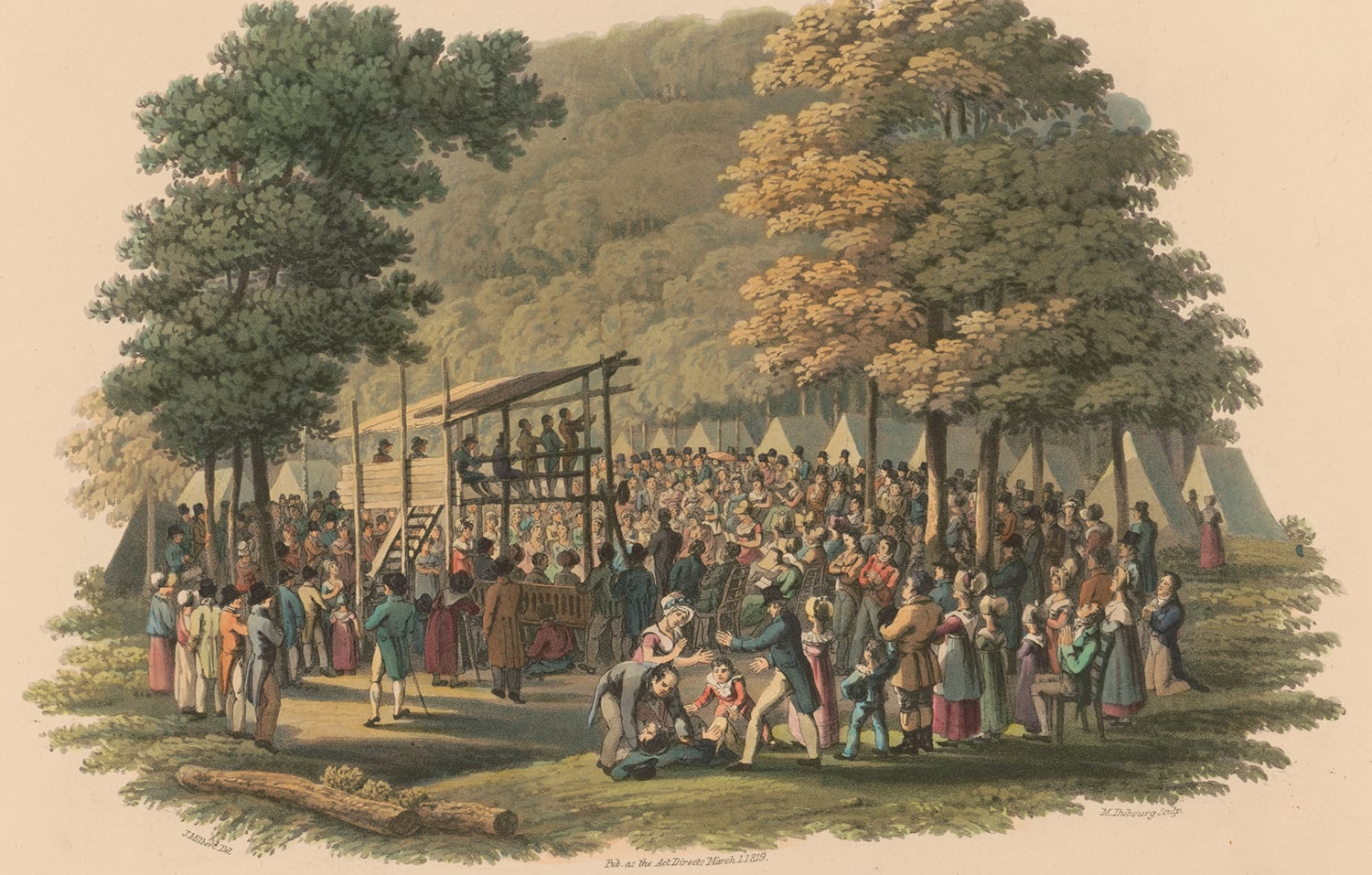
Gospel hymns were not originally intended for corporate Lord’s Day services. They were meant for revival meetings, informal Christian gatherings, or family settings. The overwhelming popularity of Sankey and Bliss’s hymnal made it inevitable that these hymns would be incorporated into worship services. We should ask ourselves if these hymns are just as appropriate for corporate worship as they are for evangelistic meetings. If you believe that the primary function of Lord’s Day worship is to evangelize the lost, then gospel hymns may fit your theology of worship. On the other hand, if you take the position that Lord’s Day worship is primarily designed for believers to corporately praise the Lord and edify one another, then gospel hymns may not be as appropriate for that approach.
3. Labels
Understanding the intention and historical reception of the gospel hymns should make us realize that defining conservative worship music is not a black-and-white issue. Gospel hymns were not received as or designed to be a “high” form of art. However, because they used popular music styles instead of direct adaptations, they were more palatable to the high-minded critics of their day. Today, we tend to think of “conservative” and “progressive” music in terms of age (old vs. new) or style (traditional harmony vs. pop music). But if Sankey and his colleagues did not view themselves as conservatives and were comfortable with using popular music styles rather than direct adaptations of popular music, then how should we treat the gospel hymns today? They are neither new, nor do they conform to the styles of modern pop music, so can we accept them as examples of conservative hymnody? Maybe it’s time for us to consider the possibility that conservative worship depends on more than singing in four-part harmony with piano and organ instead of Hillsong with a praise band.
Conclusion
Better writers than I have written on the topic of conservative vs. progressive worship music, and to comprehensively deal with the subject is beyond the scope of this series. The purpose of these articles is not to dictate to you what is or is not acceptable as worship music. Rather, it is to challenge you to think historically and theologically about your worship practices. Many of us are content to happily exist in our traditions without having any knowledge (or even a desire for knowledge) of where those traditions come from and why we practice them. What I have personally gained from this study is a more holistic approach to hymnology. Musical change never occurs in a vacuum. As the examples I have provided show, the advent of the gospel hymn genre was directly related to theological changes of the Second Great Awakening and musical developments in revival and Sunday school songs. This perspective can and should change how we think about our own traditions. What aspects of theology and culture are influencing what we practice and what we create?
After all, the gospel hymn tradition did not end with Sankey’s Gospel Hymns Nos. 1 to 6 in 1895. If the first-generation gospel hymns were Sankey’s “The Ninety and Nine,” Bliss’s “Hold the Fort,” and Crosby’s “My Savior First of All,” then the next generation produced Bartlett’s “Victory in Jesus” and Miles’s “In the Garden.” The gospel hymns carried through the second half of the twentieth century with songs such as George Beverly Shea’s “I’d Rather Have Jesus.” Modern gospel hymnody has fragmented into “traditional” and “contemporary” camps. On the more traditional side of the spectrum, the idioms of gospel music can be seen in the hymns of Frank Garlock, Mac Lynch, and Ron Hamilton. In Contemporary Praise and Worship, the ideology behind the gospel hymns can be heard in the songs of Keith Getty, Chris Tomlin, and others.
So, the next time you open a hymnal, glance down at who wrote the text and composed the music. Look at their birth and death dates. Think about what kind of audience they were writing for. Consider what the function of the hymn might have been at its beginning — in what kind of service it would have been sung, and who would have sung it. Finally, ask what the union of text and tune communicate about God’s relationship to man and man’s relationship to God.
“For God is the King of all the earth; Sing praises with understanding” (Psalm 47:7).
“I will sing with the spirit, and I will also sing with the understanding” (1 Corinthians 14:15).
See here for Parts One, Two, Three, Four.
Discover more from Proclaim & Defend
Subscribe to get the latest posts sent to your email.