Convergence and Divergence: The Advent of Gospel Hymns
Gospel Hymns: Old Stuff in a New Box
See here for Parts One, Two, Three
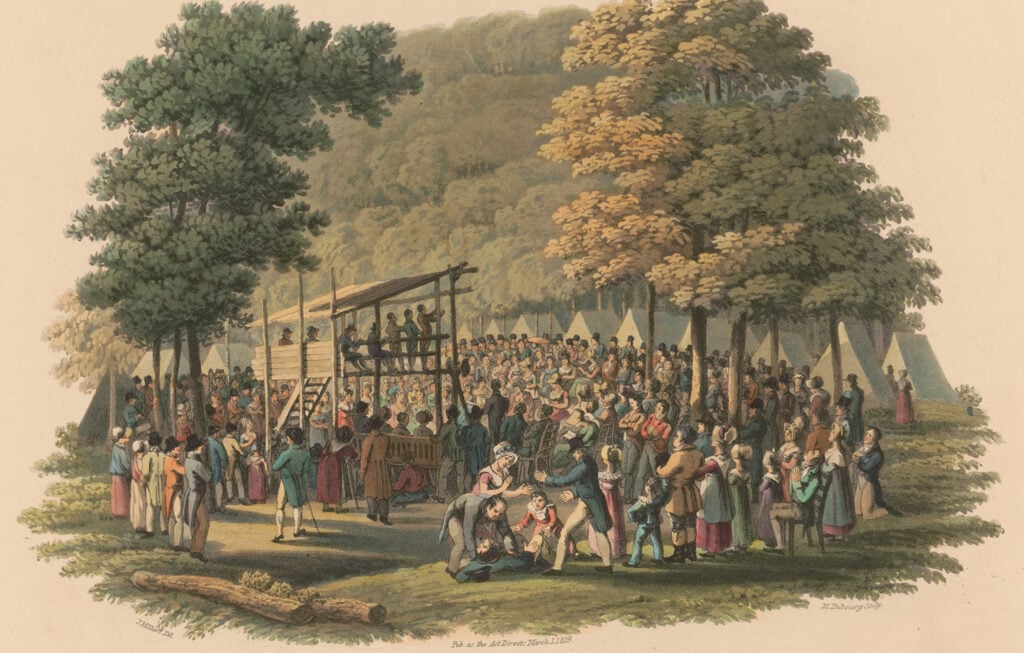
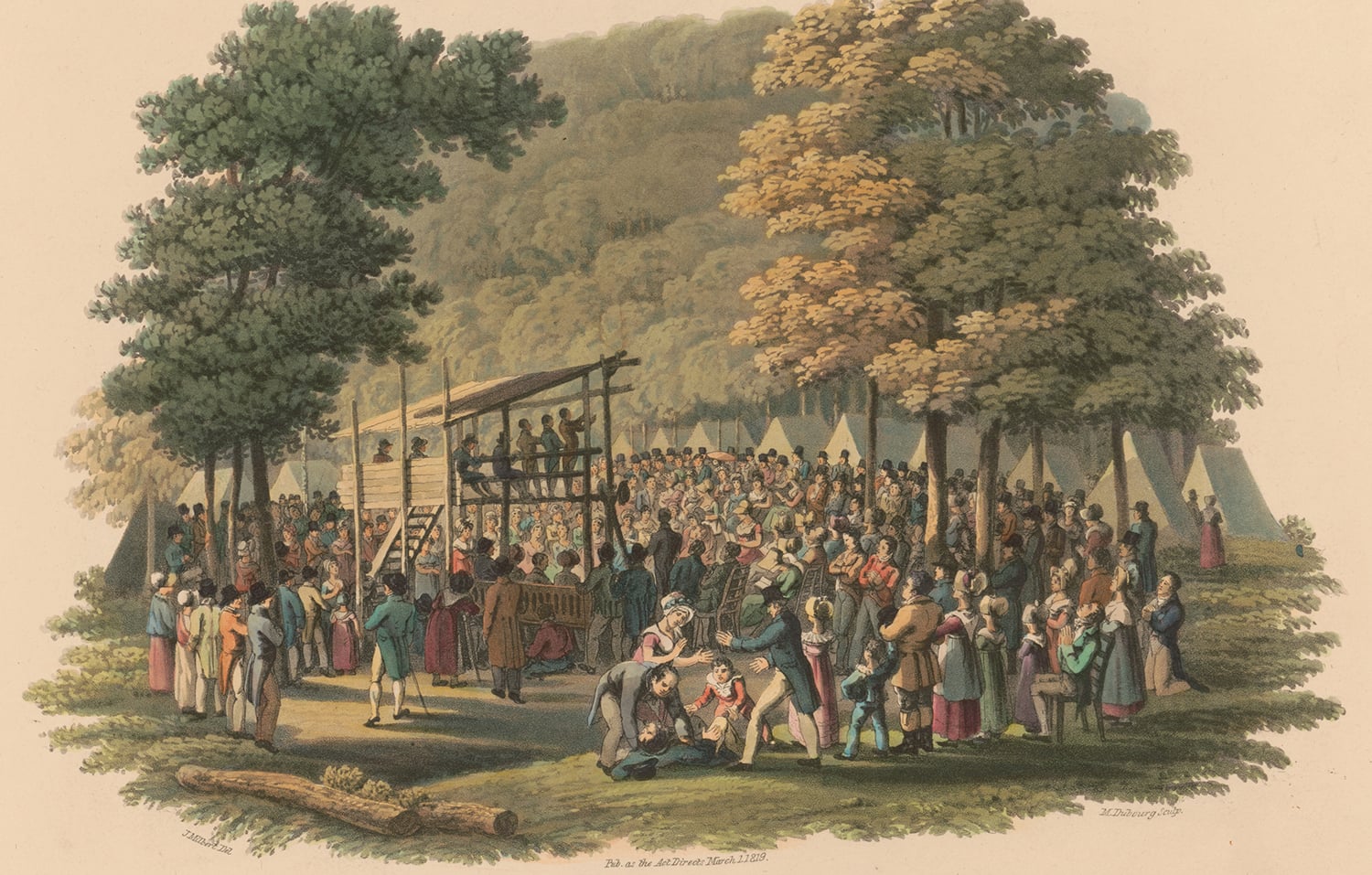
If rural southern camp meetings characterized the Second Great Awakening, then the “Prayer Meeting Revival” of 1857-58 was an awakening of the urban industrial North. William McLoughlin is rather critical of this movement, saying that it “scarcely deserved to be called the Third Great Awakening” and “it seems to have been a very respectable affair in which attending prayer meetings became the thing to do for the season.”1 The majority of attendees at Moody’s meetings belonged to the middle class, and though the days of camp-meeting hysteria were long past, they may have been chasing an emotional experience. Many were likely more concerned about social reforms than salvation.2 Though many professions of faith took place at Moody’s meetings, there was rarely lasting increase in church membership after Moody left. “It was like feeding people upon pheasants and champagne for several weeks. After the revivalist left it was hard to bring the people back to roast beef and cold water.”3
Moody was not an ordained minister, but a former shoe salesman who had turned to evangelism. Opposed to “stuffy” church services that focused on doctrine and creeds, he valued zeal above knowledge, perhaps because he himself had more force as a speaker than an intellectual knowledge of theology. His preaching style was based around relating to his enormous audience: he used slang, relied on anecdotes, and encouraged the participation of lay people in church ministries. He emphasized themes of God’s love and mercy rather than the judgment of sinners and followed the pragmatism of Charles Finney, believing any means could be used to bring more people to his services, and thereby to God.4
One of the most successful attractions of Moody’s revival services was the music, led by Ira D. Sankey. Sankey had not received any formal music education but had previously served as choir director for a Sunday school, sang solos at Sunday school conventions, and was president of a branch of the YMCA.5 It was at a YMCA convention in 1870 that his voice attracted Moody’s attention. The two joined forces as evangelists, first at Moody’s church in Chicago, next to England, Scotland, and Ireland in 1873, then returned to tour across America. McLoughlin tells us that “It was the custom to advertise Moody’s meetings with the slogan, ‘Mr. Moody will preach the gospel and Mr. Sankey will sing the gospel.’”6 Perhaps it is partially due to this that the term “gospel song” was popularized.”
Gospel Hymns and Sacred Songs (1875), compiled by Sankey and Philip P. Bliss — another composer and evangelist — was a product not only of Moody and Sankey’s fame, but of trends in sacred music led by the Sunday school movement and the YMCA. Westermeyer writes that “when adults began to carry hymns…from the Sunday school to urban revivals and church services, they became known as gospel songs or gospel hymns.”7 Louis Benson describes informal weekday “Praise Services” or “Services of Song” led by musicians like Eben Tourjée and Philip Phillips at YMCA meetings or Christian conventions that brought gospel hymns into common use by the end of the nineteenth century.8 Sankey and Bliss were only solidifying the trend in their compilation. Gospel Hymns became a series, progressing into a six-volume collection of 739 hymns by 1895.
The themes of the hymn texts fit with Moody’s message of a loving and merciful God who had a personal relationship with individual believers. As with revival songs, a major theme was the gospel message, frequently posed as an invitation to an unbeliever, such as these lines from “Come Believing!”
Once again the Gospel message
From the Savior you have heard;
Will you heed the invitation?
Will you turn and seek the Lord?9
Others were “gospel ballads,” which Rothenbusch defines as “texts that are narrative (sometimes including dialogue) but clearly based on a Scriptural or evangelical theme, to distinguish them from the sentimental semi-religious ballads in the parlor song repertory.”10 The following verse from “The Ninety and Nine,” one of the most famous hymns in the collection, provides a good example as it retells the parable of the lost sheep found in the Gospels:
There were ninety and nine that safely lay
In the shelter of the fold,
But one was out on the hills away,
Far off from the gates of gold —
Away on the mountains wild and bare,
Away from the tender Shepherd’s care,
Away from the tender Shepherd’s care.11
Like revival songs and Sunday school songs, there was a healthy dose of hymns on themes of death and heaven in Gospel Hymns. The assurance produced by a theology of free grace and unlimited atonement gave converts hope for a future in heaven along with the promise of rewards. As in camp meeting songs, metaphors of going home or crossing a river were frequently employed to describe a Christian’s journey to heaven.
The gospel hymn genre had significant heritage from revival and Sunday school music, but it also displayed original features. Esther Rothenbusch points out that “aside from its texts, perhaps the genre’s single most distinctive element is its harmonic style,” the hallmarks of which were “chromatic coloring, usually created by voice-leading and highlighted by rhythmic displacement, and a climax on a prolonged subdominant sonority preceding the final cadence.”12 An example of these kinds of features can be seen below in “You Must Be Born Again,” with music by George C. Stebbins [Ex. 2]. Chromatic neighbor tones are employed once per line in the stanza,13 and the subdominant chord (A-flat major) is held with a fermata before the chorus comes to its cadence.

[Example 2, “Ye Must Be Born Again”]14
The chorus is also a defining feature of gospel songs. By the time Gospel Hymns grew into a six-volume collection, 462 hymns (62.52%) were in stanza-chorus form, mostly with four-line stanzas and four-line choruses.15 There were other kinds of refrains that differed from the four-line chorus and bore influence from camp-meeting songs. These included the interlinear refrain, which was a repeating phrase in one or more voice parts that interacted with other lines of text, as well as a kind of echo-chorus where one voice sung a line and the other voices joined in response, as in the example below, “Calvary” [Ex. 3].

[Example 3: “Calvary”]16
There is no debate about the popularity and influence of Gospel Hymns and Sacred Songs. Within a decade, royalties from the six-volume collection had amounted to $357,338.64, and shortly after 1900, fifty million hymnals had been sold.17 Hymnals were promoted and sold at Moody’s revival meetings and at Christian conventions. Sankey and Bliss were planning a second volume of Gospel Hymns in 1875, the same year of the first volume, not because it was necessary, but because they counted on the market to be just as enthusiastic about a new number once their interest in the first had begun to wane.18
This demonstrates a shift in the production and function of hymnals. Instead of serving as a family heirloom that would be sufficient for generations, hymnals began to be treated as an accessory for churches and Christian social groups that would need to be replaced every few years to remain relevant. This was mostly for musical, not textual, reasons, since older texts continued to be preserved (albeit with choruses attached) alongside new ones. The music for gospel hymns was intended to be transient, fitting with the popular musical idioms of the day. Sanjek calls gospel hymns the “‘hit’ songs of the era” and points out that newspapers such as The Nation recognized the “secular contrivances” of Sankey’s hymns, and called them “‘a circus quickstep, a negro sentimental ballad, a college chorus, and a hymn all in one.’”19
Benson refers to Bliss and Sankey as “the heads of an evangelistic school of hymn and tune writers,” and describes their success as “a new phase of hymn singing.”20 Evangelists used Moody’s model of a preacher/singer duo, and compilers imitated the format and contents of Gospel Hymns. In many denominations, gospel hymns infiltrated beyond Sunday schools and informal meetings, threatening to supplant the “established Hymnody” of corporate worship.21
Many gospel songs have lasted in evangelical churches to the present day, but the larger legacy of Gospel Hymns and Sacred Songs is the philosophical approach to hymns and hymnals. Compilers and hymnwriters shifted their values from a desire to improve the aesthetic quality of hymns to the goal of creating an attractive, familiar style of hymn that would produce more converts — and sell more copies. The appeal of popular music styles blurred the line between secular and sacred music. This corresponded to theological changes from a doctrine-heavy Calvinism to a pragmatic evangelical emphasis on free will and soul-winning. Gospel Hymns and Sacred Songs exhibited features of former traditions and created its own characteristics. It was both influenced and influential, unifying the smaller genres of revival and Sunday school music into one new genre and redefining the canon of evangelical hymnody.
[Ed. Note: This series traces the historical development of revival music. As we look back, we also look forward in hope. We need true revival without the excesses of human manipulation that often occur alongside the work that the Holy Spirit is truly doing.]
Bibliography:
Benson, Louis F. The English Hymn: Its Development and Use in Worship. George H. Doran Co., 1915.
Downey, James C. “Revivalism, the Gospel Songs, and Social Reform.” Ethnomusicology 9, no. 2 (1965): 115-125.
McLoughlin, William G. Modern Revivalism: Charles Finney to Billy Graham. Wipf and Stock Publishers, 2004 (prev. Ronald Press Company, 1959).
Rothenbusch, Esther H. “The Role of Gospel Hymns Nos. 1 to 6 (1875-1894) in American Revivalism.” PhD diss., University of Michigan, 1991.
Sanjek, Russell. American Popular Music and Its Business: The First Four Hundred Years. Vol. 2, From 1790 to 1909. Oxford University Press, 1988.
Sankey, Ira D., Philip P. Bliss, James McGranahan, and Geo C. Stebbins, comps. Gospel Hymns Nos. 1 to 6. Biglow & Main Co., 1895.
Sankey, Ira D. Sankey’s Story of the Gospel Hymns and of Sacred Songs and Solos. The Sunday School Times Co., 1906.
Westermeyer, Paul. Te Deum: The Church and Music. Augsburg Fortress Press, 1998.
- McLoughlin, Modern Revivalism, 163-64. [↩]
- James C. Downey, “Revivalism, the Gospel Songs and Social Reform,” Ethnomusicology 9 (1965), 116. [↩]
- McLoughlin, Modern Revivalism, 266-67. [↩]
- Ed. Note: Although pragmatic in approach, Moody didn’t share the serious theological errors of Finney. [↩]
- Ira D. Sankey, Sankey’s Story of the Gospel Hymns and of the Sacred Songs and Solos (The Sunday School Times Co., 1906), 5. [↩]
- McLoughlin, Modern Revivalism, 234. [↩]
- Westermeyer, Te Deum, 268. [↩]
- Benson, The English Hymn, 484-85. [↩]
- Ira D. Sankey et al., comps., Gospel Hymns Nos. 1 to 6 (Biglow & Main Co., 1895), 175. [↩]
- Rothenbusch, “The Role of Gospel Hymns Nos. 1 to 6,” 180. [↩]
- Sankey et. al., Gospel Hymns Nos. 1 to 6, 410-11. [↩]
- Rothenbusch, “The Role of Gospel Hymns Nos. 1 to 6,” 203, 205. [↩]
- “Chromatic coloring” is the use of sharps, flats, or naturals that do not belong to the key signature, also called accidentals. A chromatic neighbor tone is achieved by moving a half-step away from a pitch and then moving back to the pitch. In Example 2, chromatic neighbor tones can be seen on the words “Jesus by night” in the soprano and alto parts. [↩]
- Sankey et al., Gospel Hymns Nos. 1 to 6, 87. [↩]
- Rothenbusch, “The Role of Gospel Hymns Nos. 1 to 6,” 186. [↩]
- Sankey et al., Gospel Hymns Nos. 1 to 6, 260. [↩]
- Sanjek, American Popular Music and Its Business, 250-51. [↩]
- Rothenbusch, “The Role of Gospel Hymns Nos. 1 to 6,” 290-91. [↩]
- Sanjek, American Popular Music and Its Business, 251. [↩]
- Benson, The English Hymn, 487-88. [↩]
- Benson, The English Hymn, 490. [↩]
Discover more from Proclaim & Defend
Subscribe to get the latest posts sent to your email.