Convergence and Divergence: The Advent of Gospel Hymns
Part One
Most of us have heard the name Ira Sankey. He was the famous singing evangelist who traveled with Dwight L. Moody across England and America. Even if you don’t know Sankey’s name, you may recognize his hymns, such as “A Shelter in the Time of Storm” or “Trusting Jesus.” Along with Philip Bliss, Sankey compiled and published the hymnal Gospel Hymns and Sacred Songs in 1875, which redefined evangelical church music. The fact that many of its contents are recognizable to us today is a testament to its lasting popularity, but it was a massive success in its own day, selling millions of copies and growing into a six-volume collection by 1895.1 It became a model for similar publications and was used not only for revivals but also in worship services, threatening to replace the older psalms and hymns in common use. This remarkable popularity is precisely what shouldn’t make sense if the musical idioms of Gospel Hymns were drastically different from what Americans were familiar with. From a twenty-first-century perspective, the music of this hymnal may seem like a departure from what were traditionally considered standard psalms and hymns, but evidence suggests that the gospel hymn genre was both a fusion of past traditions and a step away from tradition.
In this five-part series, I will tell the story of how the gospel hymn genre came into being, answering the questions of where it came from, what its distinctive features are, and why an understanding of it is still relevant. My goal is not just to provide a musical understanding of the genre, but to show how the development of gospel hymns corresponded to theological and cultural changes taking place within American Christianity in the nineteenth century.
Nicholas Tawa writes of early nineteenth-century Americans that “prayer and hymn-singing were a part of the daily experience, whether at home, at a neighbor’s, or at a meetinghouse. A large portion of every American’s musical repertoire consisted of sacred music, much of it acquired when young.”2 Psalters, hymnals, and general songbooks were primarily owned by individuals or families rather than churches. But not all sacred music was the same. What was sung in corporate worship meetings was different from what was sung at revival meetings, prayer meetings, Sunday schools, or family gatherings.
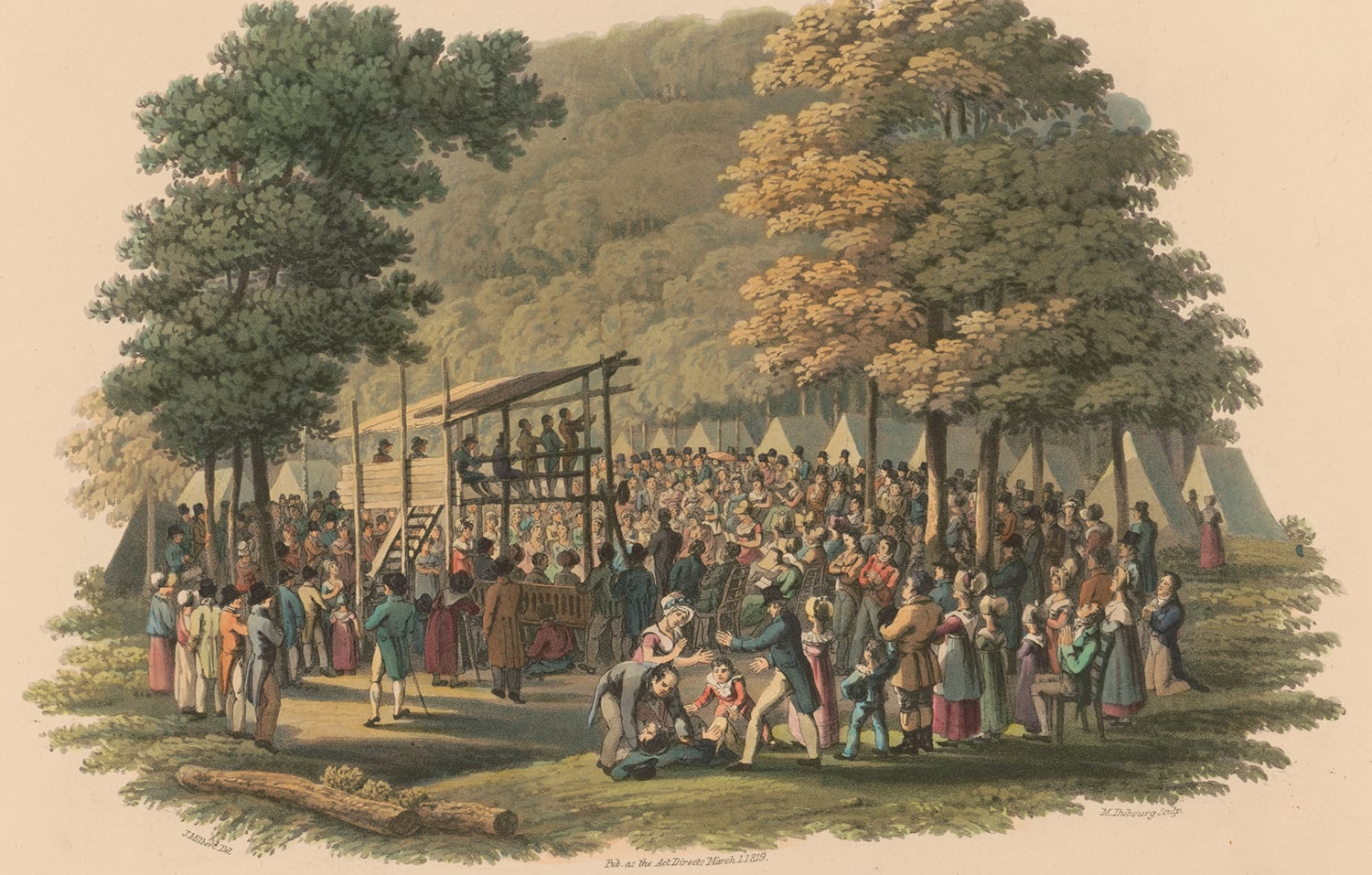
Revivals would have been familiar to nineteenth-century Americans. The 1800s witnessed two spiritual awakenings, one from 1795-1835 (the Second Great Awakening) and another from 1875-1915. In Modern Revivalism, William G. McLoughlin associates these awakenings with times of “reexamination and redefinition of the nation’s social and intellectual values which must take place from time to time in order to maintain a balance between tradition and change,” and defines awakenings as “the religious aspects of such transitional periods in American history.”3 In general, awakenings demonstrate a return to religious personal values by those who have fallen away from faith and place a heavy emphasis on evangelism. America’s first awakening, generally referred to as the “Great Awakening,” occurred during the eighteenth century, extending roughly from 1725-1750. Revivals can be differentiated from awakenings in that they are times of spiritual rejuvenation on a local rather than national level.
The established Protestant church music tradition of the eighteenth century was predominantly psalmody, though collections of hymns were rapidly being introduced as supplements to psalters at the turn of the nineteenth century. As Louis Benson defined it in 1915, a hymn was “an evangelical interpretation of revealed truths as appropriated by the believer” that “became primarily an expression of Christian experience.” In contrast, he described psalms as expressions of the “adoration of God in nature and providence.”4
Technically speaking, sung psalms were metrical paraphrases of the Scriptural psalms, while hymns were stanzaic poems on themes of God’s character and Christian devotion, and were more homiletical in nature. Both psalters and hymnals were printed and published in text-form only; tunebooks were purchased separately.
Late eighteenth-century tunebooks for psalms and hymns provide evidence that Americans were capable of reading music, largely owing to the exponential growth of singing schools. Singing rapidly in harmony took the place of the older “lining-out” tradition of unison call-and-response singing.5 Oblong tunebooks in four-part harmony were published for singing schools and church choirs and included rudimentary instruction for reading musical notation in their introductory material. James Lyon’s Urania (1761) and William Billings’s The New England Psalm Singer (1770) introduced fuguing tunes to American congregations. These were most often characterized by a four-line stanza in which the first, second, and last lines were in blocked chordal harmony and the third line would break the voices into overlapping contrapuntal entrances on the same text [see Ex. 1].6
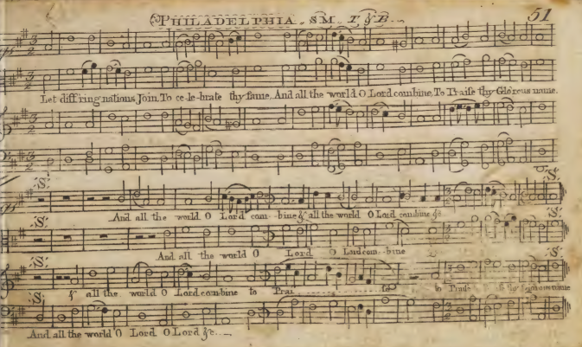
[Example 1: “Philadelphia” by William Billings]7
Fuguing tunes were widely accepted by American churches as musical literacy grew, but their level of difficulty meant that they were less accessible for congregational singing.
The collections of psalm and hymn texts that became the standards in America were by Isaac Watts. His volume of Hymns and Spiritual Songs was published in London in 1707, and his Psalms of David Imitated in the Language of the New Testament and Apply’d to the Christian State and Worship followed in 1719.8 These volumes were successful in England to the point where “the feeling for Watts’ Psalms and Hymns…grew into an intense personal loyalty.”9The American Puritans were more hesitant to accept the Hymns and the updated language of the Psalms. The Psalms of David made its way to Benjamin Franklin’s Philadelphia press in 1729, but did not receive a second printing until twelve years later. The first American printing of Hymns and Spiritual Songs came in 1739 in Boston. The spirit of change that accompanied the Great Awakening, along with the endorsement of preachers such as George Whitefield and Jonathan Edwards, ultimately resulted in the common use of Watts’s collections in New England shortly after the American Revolution.10
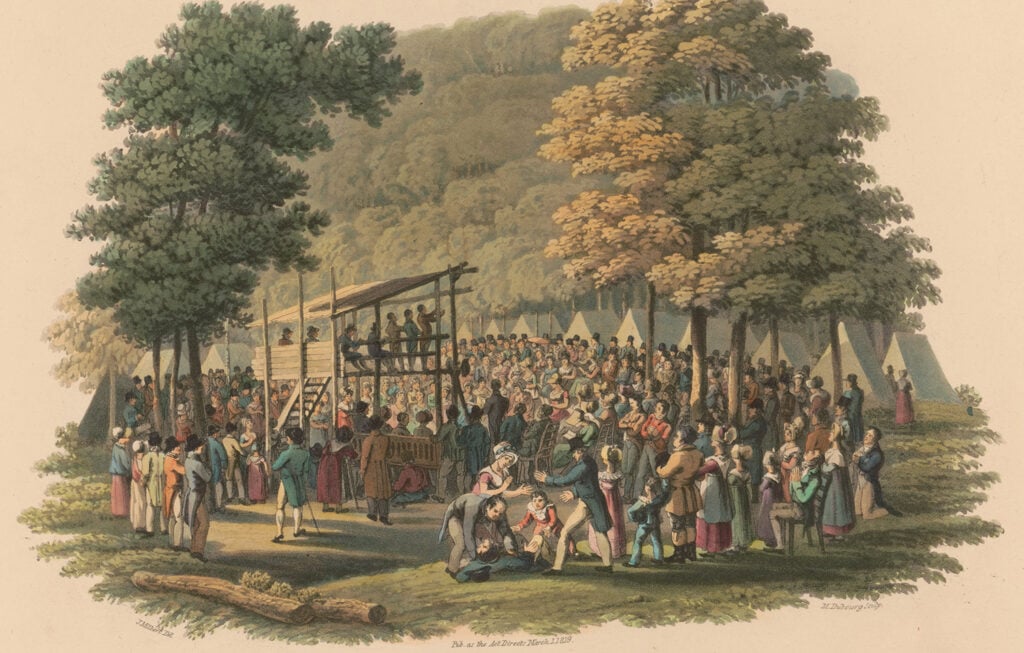
One other English compiler of hymns became familiar to Americans. John Wesley (1703-1791) was a founder of the Methodist denomination who sought to reform the liturgical traditions of the Anglicans. Wesley and his brother Charles wrote and compiled hymns to be used in the Methodist church. As missionaries, they made several trips to America, beginning with Savannah, Georgia in 1735.11 The Americans gave a warm welcome to the Wesley brothers’ hymns, but Wesley’s “high church” ideals did not fit very well with rural Methodists who worshiped in cabins or even outdoors. Though the Psalms and Hymns attached to Wesley’s The Sunday Service (1784) was the first authorized American Methodist hymnbook, Americans gravitated towards A Pocket Hymnbook for the use of Christians of all denominations (1787), a collection by American publisher Robert Spence that contained some Wesley texts alongside others that had not been approved by the church.12 This hymnbook was commonly used during the Methodist camp meeting revivals during the first decade of the nineteenth century.
These revivals mark the beginning of the Second Great Awakening, but it is important to note that this awakening was different from the First. The Great Awakening before the Revolution had also featured outdoor gatherings and evangelism, but the very concepts of awakenings and revivals began to change during the 1800s. This would have implications on the doctrines and practices of the nineteenth-century evangelical church.
The most fundamental difference between the First and Second Great Awakenings was the idea of how awakenings begin. The theological leaders of the First Great Awakening saw revivals as seasons of time “when the Spirit is given in exceptional measure” that “may come suddenly, even when deadness is general in the church and indifference to biblical religion prevails in society at large.”13 McLoughlin characterized “the old revival tradition” as one that believed “a revival was a miraculous act of divine grace,” or “a heavenly ‘shower of blessings’ over which a revivalist had no more control than the farmer had control over a shower of rain.”14
In contrast to this theocentric view of awakenings, the Second Great Awakening took a more human-centered approach. Revivals were treated almost like a science, where the desired results could be manufactured by the right methods. Charles Finney, the most prominent evangelist of the Second Great Awakening, wrote in his Lectures on Revivals that a revival is “a purely philosophical result of the right use of the constitutional means.”15
This difference also corresponded to the theological changes taking place, particularly as the doctrine of salvation shifted from a Calvinist to Arminian view. Calvinism taught that individuals were elected or predestined by God to receive salvation from eternal damnation, whereas Arminians placed a much higher emphasis on man’s free will to choose salvation. If man had the power to choose between eternal life and eternal damnation, then it logically followed that believers would do all in their power to convert others—to evangelize. The role of the pastor began to shift from that of expositing Scripture to that of soul-winning. In the next article I will show how the role of church music began to change too.
[Ed. Note: This series traces the historical development of revival music. As we look back, we also look forward in hope. We need true revival without the excesses of human manipulation that often occur alongside the work that the Holy Spirit is truly doing.]
Bibliography:
Billings, William, comp. The Singing Master’s Assistant […]. Boston, 1778.
Benson, Louis F. The English Hymn. The Presbyterian Board of Publication, 1915.
Christ-Janer, Albert, Charles W. Hughes, and Carleton Sprague Smith. American Hymns Old and New. Columbia University Press, 1980.
Crawford, Richard. “Fuging-tune.” Grove Music Online. 31 Jan. 2014; Accessed 18 Mar. 2026. https://doi-org.ezproxynec.flo.org/10.1093/gmo/9781561592630.article.A2256601.
McLoughlin, William G. Modern Revivalism: Charles Finney to Billy Graham. Wipf and Stock Publishers, 2004. Originally published in 1959 by Ronald Press Company.
Murray, Iain H. Revival and Revivalism: The Making and Marring of American Evangelicalism 1750-1858. The Banner of Truth Trust, 1994.
Tawa, Nicholas E. High-Minded and Low-Down: Music in the Lives of Americans 1800-1861. Northeastern University Press, 2000.
Westermeyer, Paul. Te Deum: The Church and Music. Augsburg Fortress Press, 1998.
- Paul Westermeyer, Te Deum: The Church and Music (Augsburg Fortress Press, 1998), 268. [↩]
- Nicholas Tawa, High-Minded and Low-Down: Music in the Lives of Americans 1800-1861 (Northeastern University Press, 2000), 90. [↩]
- William G. McLoughlin, Modern Revivalism: Charles Grandison Finney to Billy Graham (Wipf and Stock, 2004), 7. [↩]
- Louis F. Benson, The English Hymn (The Presbyterian Board of Publication, 1915), 208. [↩]
- This tradition of “lining-out” the psalms was criticized because it “slowed the pace of singing, broke the shape of a psalm into a line-by-line, call-and-response pattern, and encouraged improvised turns and flourishes.” Westermeyer, Te Deum, 248. [↩]
- Grove Music Online, “Fuguing Tune,” by Richard Crawford, published online January 31, 2014, accessed March 18, 2024. https://www.oxfordmusiconline.com/grovemusic/view/10.1093/gmo/9781561592630.001.0001/omo-9781561592630-e-1002256601 [↩]
- William Billings, The Singing-Master’s Assistant […] (Boston, 1778), 51. [↩]
- Benson, The English Hymn, 115-16, and Albert Christ-Janer et al., American Hymns Old and New (Columbia University Press, 1980), 114. [↩]
- Benson, The English Hymn, 125. [↩]
- Benson, The English Hymn, 166. [↩]
- Benson, The English Hymn, 223. [↩]
- Benson, The English Hymn, 238. [↩]
- Iain H. Murray, Revival and Revivalism: The Making and Marring of American Evangelicalism 1750-1858 (The Banner of Truth Trust, 1994), 21. [↩]
- McLoughlin, Modern Revivalism, 32. [↩]
- Charles Finney, Lectures on Revivals (New York, 1868), quoted in McLoughlin, Modern Revivalism, 84. [↩]
Discover more from Proclaim & Defend
Subscribe to get the latest posts sent to your email.