Convergence and Divergence: The Advent of Gospel Hymns
Part Three
Sunday School Music: Evangelizing the Children
See here for Parts One and Two
Sunday schools existed in New England as early as 1669 and in southern states in 1785.1 In the 1790s they grew more numerous in urban industrial centers. Their primary function then was “to provide rudimentary instruction to poor working children on their only free day of the week.”2 They used religious texts such as catechisms, hymns, and scripture passages to teach reading, writing, and memorization. Sunday schools began to be institutionalized as early as 1791, when a group of men from various Christian denominations founded the First Day Society.3 Though the First Day Society emphasized teaching reading and writing over religious instruction, their curricular material came from the Bible. By the 1820s, Sunday schools had become a primarily evangelical enterprise, focusing on the conversion of young souls rather than just teaching them how to read and write. Boylan notes that “By the late 1830s the various Sunday school unions had virtually ceased discussing the teaching of reading in their reports.”4
Though this was partly due to the growth of free public schools, it can also be attributed to the turn from Calvinism to evangelicalism that accompanied the Second Great Awakening. Calvinism taught that all children were inherently depraved and could not experience true conversion until adulthood. Children were therefore treated as miniature adults and were “expected to live in an adult world where children’s books and little sacred songs were irrelevant.”5 The influence of revivalists like Finney “produced a reorientation of the goals of many Sunday school teachers with greater stress on conversion.”6
These shifts in philosophy can be seen in Sunday school hymnody. Instead of children using the same hymns as adults, new texts and tunes were specifically composed and compiled for Sunday school children. One of the earliest collections, The Juvenile Psalmist, compiled in 1827 by Thomas Hastings, demonstrates the beginnings of this change. It was an upright (not oblong), thirty-six-page book that contained texts as well as tunes. As the title of the book implies, the tunes were primarily drawn from the old New England psalm-singing traditions, but the texts included “both hymns from the standard body of hymnody in use in 1827, and hymns written particularly for children.”7 It also notably contained an introduction to the rudiments of music, designed for class instruction. It would be standard practice for Sunday school books to include a section on the fundamentals of reading music until the 1850s. The intentional pairing of texts and tunes was also an important feature that would become ubiquitous among Sunday school songbooks.
The tunes used for Sunday school collections grew more diverse through the 1840s and 50s. Cross writes, “Both revival songs and popular songs interacted with the corpus of standard hymn tunes in the Masonic [that is, of Lowell Mason] tradition as composers attempted to produce music for Sunday schools that would be affective and appealing.”8 Like Joshua Leavitt (see the previous article) most Sunday school compilers associated musical simplicity with camp meeting tunes and popular music. However, composers did not rely solely on contrafacts9 of secular tunes. Rather they chose to write tunes that bore stylistic similarity to popular music. One composer, George Frederick Root (1820-1895), was primarily known for his secular songs but used the same style in his own Sunday school tunes, even collaborating on a songbook called Chapel Gems (1866).10
William Batchelder Bradbury (1816-1868) was one of the most influential composers of the Sunday school hymnody. He is known for writing the music to “Jesus Loves Me,” “Just As I Am,” and “Savior, Like A Shepherd Lead Us,” to name a few. His series of Sunday school songbooks published in the 1860s brought the Sunday school music style into maturity as its own genre. He studied at Lowell Mason’s Boston Academy of Music and in 1841 launched his career as a church musician in New York. He traveled to Europe in the 1850s to receive further training in piano and composition and returned to New York in 1854 to teach at George Root’s brand-new Normal Musical Institute.11 Though Bradbury had been involved as a co-compiler of church music collections with Thomas Hastings in the 1840s, he founded a publishing company in 1861 to compile songbooks on his own. The most popular (and lucrative) products of Bradbury Publishers were by far his Sunday school songbooks.
Bradbury’s “Golden” songbooks, The Golden Chain (1861), The Golden Shower (1862), and The Golden Censer (1864), mark the peak of the Sunday school musical style. Because the primary concern was to create an attractive and accessible melody, harmonic rhythm (the rate at which the chords change) was slower with chord changes as infrequent as once per bar. Bass lines were generally built around root position chords, while melodies were oriented around stepwise motion, small chordal skips around triads, and frequent repetition. This melody-centric approach to composition also produced lilting and vigorous rhythms such as quarter notes followed by eighth notes in 6/8 meter, or dotted eighths plus sixteenth notes. The use of minor keys was almost entirely abandoned, probably due to the strong emphasis on happiness in the texts and possibly the perceived exoticism of minor keys.
The poetry itself also displayed new characteristics. The dotted and lilting rhythms noted above point to an increased usage of iambic foot. Writers were by this time creating hymns with built-in choruses rather than writing standalone refrains to be attached to a multitude of songs. The chorus was common to both revival and popular music, so it should be no surprise that fifty-five percent of Bradbury’s hymns in The Golden Chain have their own chorus.12 The subject matter was child-oriented, evangelistic, and occasionally dealt with cultural issues such as the temperance movement and patriotism. Sentimentalism can be seen in the frequency of texts on the death of children and imagery of angels. The gentle and loving attributes of God were emphasized, as in the below example from Bradbury’s Golden Shower portraying Christ as a loving Shepherd and children as his lambs [Ex. 1].
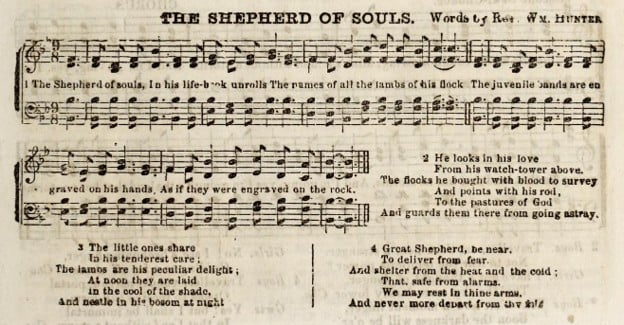
[Example 1: “The Shepherd of Souls,” in The Golden Shower (1862)]13
This example also demonstrates the musical features discussed above, such as a syllabic melody and simple harmonies with infrequent chord changes. These kinds of sentimental songs were not unlike the secular parlor ballads of the day, while other texts bore similarity to camp meeting songs in their use of repetition, imagery of heaven, and even words such as “hallelujah” and “Canaan.”
The fact that more popular songs were not borrowed for Sunday school use is likely due to the influence of “scientifically” trained musicians like Hastings and Bradbury who criticized direct contrafacts of popular tunes. However, the unquestionable stylistic similarity to popular songs seems to be inconsistent with their values. Tawa partly blames poets, who “had the half-formed taste that characterized the multitudes, although they were sincerely convinced they aimed at a higher standard,” but he recognizes that even “well-meaning musicians” like Hastings, Bradbury, and Root “could not cancel out the secular sounds of sentimental and traditional ballads, of dance songs and minstrel tunes.”14
It is also difficult to say that there was a unilateral influence from popular music to Sunday school music. By the 1860s the line between the genres was becoming increasingly blurred. Beyond musical similarities, the commercial nature of Sunday school music production — the enormous numbers of sales plus the constant demand for new material — is evidence that Sunday school music could be considered popular music itself. These books sold hundreds of thousands of copies. Bradbury’s Golden Chain reportedly sold over one million copies the year it was published.15 Why should they worry about combatting the supposedly negative influence of popular music if it led to the conversion of new believers? The same kind of pragmatism that justified the contrafacts in The Christian Lyre in the 1830s now seemed to justify the popular music style in the 1850s and 60s — but with far less opposition, if any.
The audience for Sunday school songs was also expanding beyond the Sunday school. In the next article, I will examine the so-called “Prayer Meeting Revival” of 1857-58, which ushered in an era of pietistic fervor and urban social reform. It was led primarily by itinerant evangelist Dwight L. Moody. This Third Great Awakening saw the formation of the Gospel Hymn genre, which I hope to show was connected to the previously discussed genres of revival music and Sunday school music.
[Ed. Note: This series traces the historical development of revival music. As we look back, we also look forward in hope. We need true revival without the excesses of human manipulation that often occur alongside the work that the Holy Spirit is truly doing.]
Bibliography:
Boylan, Anne M. Sunday School: The Formation of an American Institution 1790-1880. Yale University Press, 1988.
Bradbury, William. Bradbury’s Golden Shower of S.S. Melodies: A New Collection of Hymns and Tunes for the Sabbath School […]. New York, 1862.
Cross, Virginia Ann. “The Development of Sunday School Hymnody in the United States of America, 1816-1869.” DMA diss., New Orleans Baptist Theological Seminary, 1985.
Eskew, Harry. “Bradbury, William Batchelder.” Grove Music Online. 16 Oct. 2013; Accessed 18 Mar. 2026. https://doi-org.ezproxynec.flo.org/10.1093/gmo/9781561592630.article.A2248469.
Rothenbusch, Esther H. “The Role of Gospel Hymns Nos. 1 to 6 (1875-1894) in American Revivalism.” PhD diss., University of Michigan, 1991.
Tawa, Nicholas E. High-Minded and Low-Down: Music in the Lives of Americans 1800-1861. Northeastern University Press, 2000.
- Virginia Ann Cross, “The Development of Sunday School Hymnody in the United States of America, 1816-1869” (DMA diss., New Orleans Baptist Theological Seminary, 1985), 38. [↩]
- Anne M. Boylan, Sunday School: The Formation of an American Institution 1790-1880 (Yale University Press, 1988), 6. [↩]
- Boylan, Sunday School, 7. [↩]
- Boylan, Sunday School 24. [↩]
- Nicholas Tawa, High-Minded and Low-Down: Music in the Lives of Americans 1800-1861 (Northeastern University Press, 2000), 216. [↩]
- Cross, “The Development of Sunday School Hymnody,” 58. [↩]
- Cross, “The Development of Sunday School Hymnody,” 227-28. [↩]
- Cross, “The Development of Sunday School Hymnody,” 98. [↩]
- “A contrafact is a musical work based on a prior work.” “Contrafact,” Wikipedia, March 15, 2026. [↩]
- Cross, “The Development of Sunday School Hymnody,” 504. [↩]
- Grove Music Online, “Bradbury, William Batchelder,” by Harry Eskew, published online October 16, 2013, accessed March 18, 2026, https://doi-org.ezproxynec.flo.org/10.1093/gmo/9781561592630.article.A2248469. [↩]
- Cross, “The Development of Sunday School Hymnody,” 455. [↩]
- William Bradbury, comp., Bradbury’s Golden Shower of S. S. Melodies: A New Collection of Hymns and Tunes for the Sabbath School (New York, 1862), 19. [↩]
- Tawa, High-Minded and Low-Down, 219. [↩]
- Esther Rothenbusch, “The Role of Gospel Hymns Nos. 1 to 6 (1875-1894) in American Revivalism” (PhD diss., University of Michigan, 1991), 289. [↩]
Discover more from Proclaim & Defend
Subscribe to get the latest posts sent to your email.