
Some of you new students may not understand just exactly why we take the position we take in regard to Billy Graham’s ecumenical evangelism…. Billy Graham and I have been for many years personal friends. This is not a personal difference between my father and Dr. Graham — that is what defenders of Dr. Graham’s policies try to imply. There is nothing personal in our stand. I would to God that Billy Graham were following a Scriptural program so we could endorse it. We are against anything unscriptural; and, therefore, we have to take a stand against this ecumenical evangelism, even when it is our friends who are guilty of Scriptural disobedience. It is not because Dr. Graham is involved — it is in spite of the fact that Dr. Graham is involved — that we have to take our stand…. I am not questioning Dr. Graham’s sincerity; I am not questioning his motives. I am only saying that what he is doing is unscriptural; and, therefore, Bob Jones University cannot endorse it.
—Bob Jones Jr.
The fundamentalist movement took shape around two great controversies. The first was a struggle with religious liberalism for control of the old, main-line denominations. Fundamentalists lost that fight almost everywhere. As they exited their denominations, they built up a large, independent network of both new denominations (e.g., the IFC and the GARBC) and non-denominational institutions. These institutions included schools, missions, book houses, magazines, papers, evangelistic agencies, inter-church councils, radof Graham, but Graham also served on Rice’s board. When Graham committed himself to cooperative evangelism in 1956, no one felt the rupture more deeply than Rice. The older evangelist shed many tears when he found himself opposed to his younger protégé. But John R. Rice never, ever stopped loving Billy Graham.
Anyone who wants to understand the fundamentalist view of Billy Graham has to remember just how deeply Billy was loved in fundamentalist circles and how heavily fundamentalist leaders had invested in his ministry. When Billy adopted the method of cooperative evangelism, they could hardly believe it. Worse, Billy was using his old, fundamentalist connections to draw people into cooperative evangelism after him. That is when disbelief gave way to disappointment, and disappointment to a necessary, public opposition. The difference was a serious one, and these leaders felt the need to say something, since Graham threatened to sweep their followers after him by the strength of his charisma. They felt perplexed and betrayed. But they never stopped loving Billy Graham, even when they disagreed publicly and sharply with his methods.
Those leaders of separatist fundamentalism all went to be with the Lord in heaven long ago, but their young protégé lived to ninety-nine years. Then last week he, too, slipped home into heaven. By now he has embraced Monk, and Doc, and John R., and the Joneses. Fellowship that was broken more than half a century ago has now been healed, and it will never be broken again. We long for the day when that can be said of all of us.
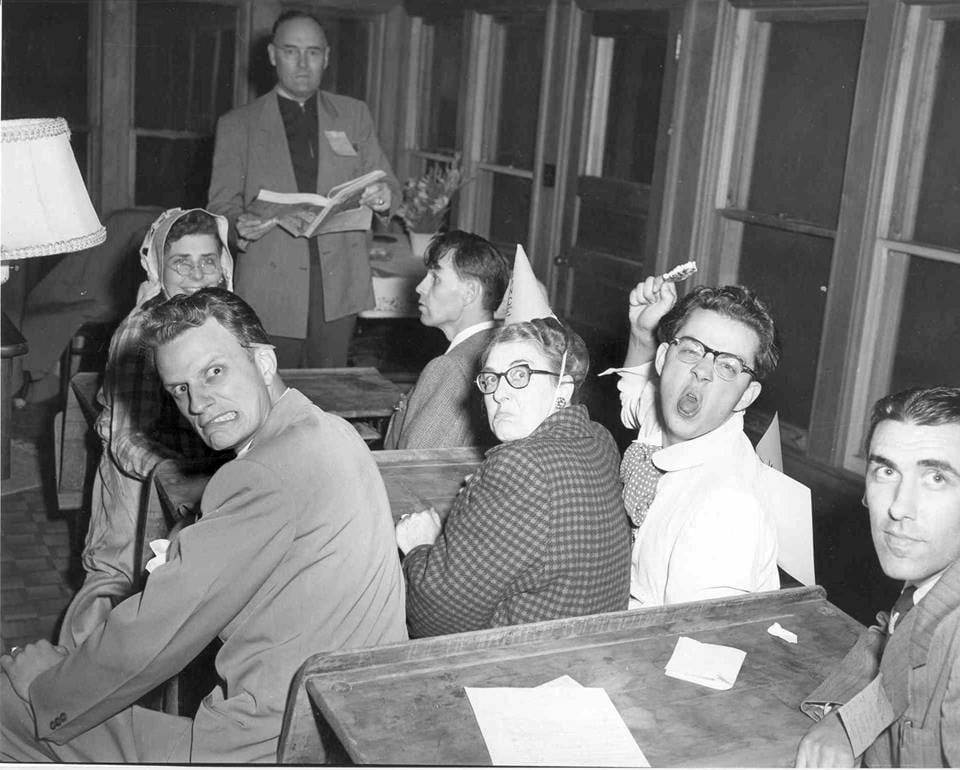
Photo provided courtesy of Drs. Charles and Helen Aling. Taken by Don Nelson at Northwestern Schools in late 1948. Pictured are Richard V. Clearwaters (speaking), Jean Makas, Leroy Gager, Billy Graham, Marie Acomb Riley, George Makas, and Gerry Bevin.
This essay is by Kevin T. Bauder, Research Professor of Historical and Systematic Theology at Central Baptist Theological Seminary. Not every one of the professors, students, or alumni of Central Seminary necessarily agrees with every opinion that it expresses.
This essay first appeared here, and is republished here with permission.
Discover more from Proclaim & Defend
Subscribe to get the latest posts sent to your email.