Convergence and Divergence: The Advent of Gospel Hymns
Part Two
See here for Part One
Revival Music: Sacred vs. Secular
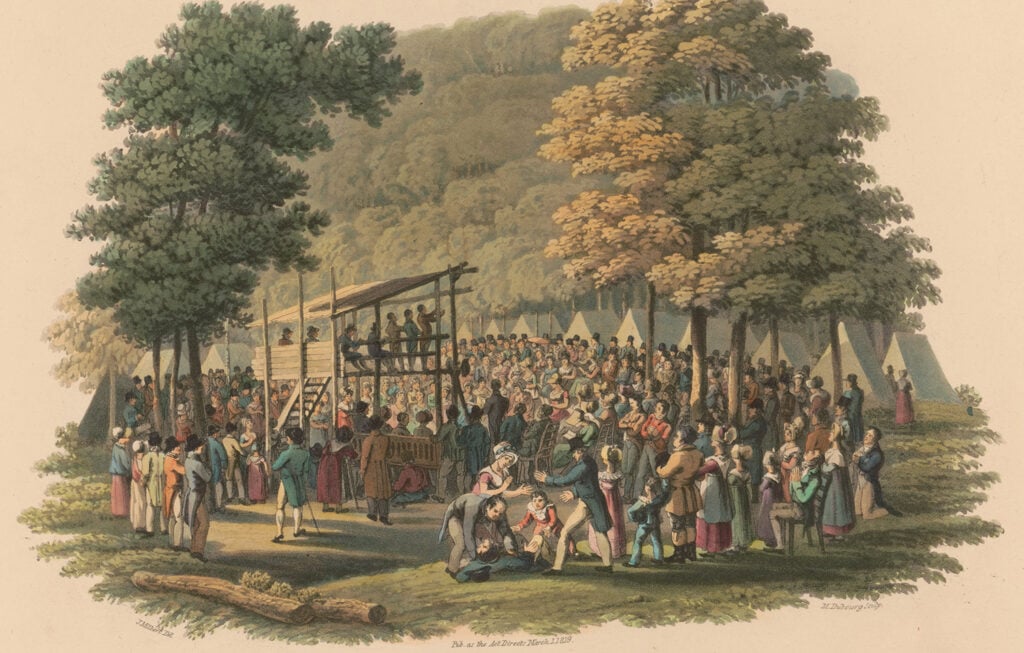
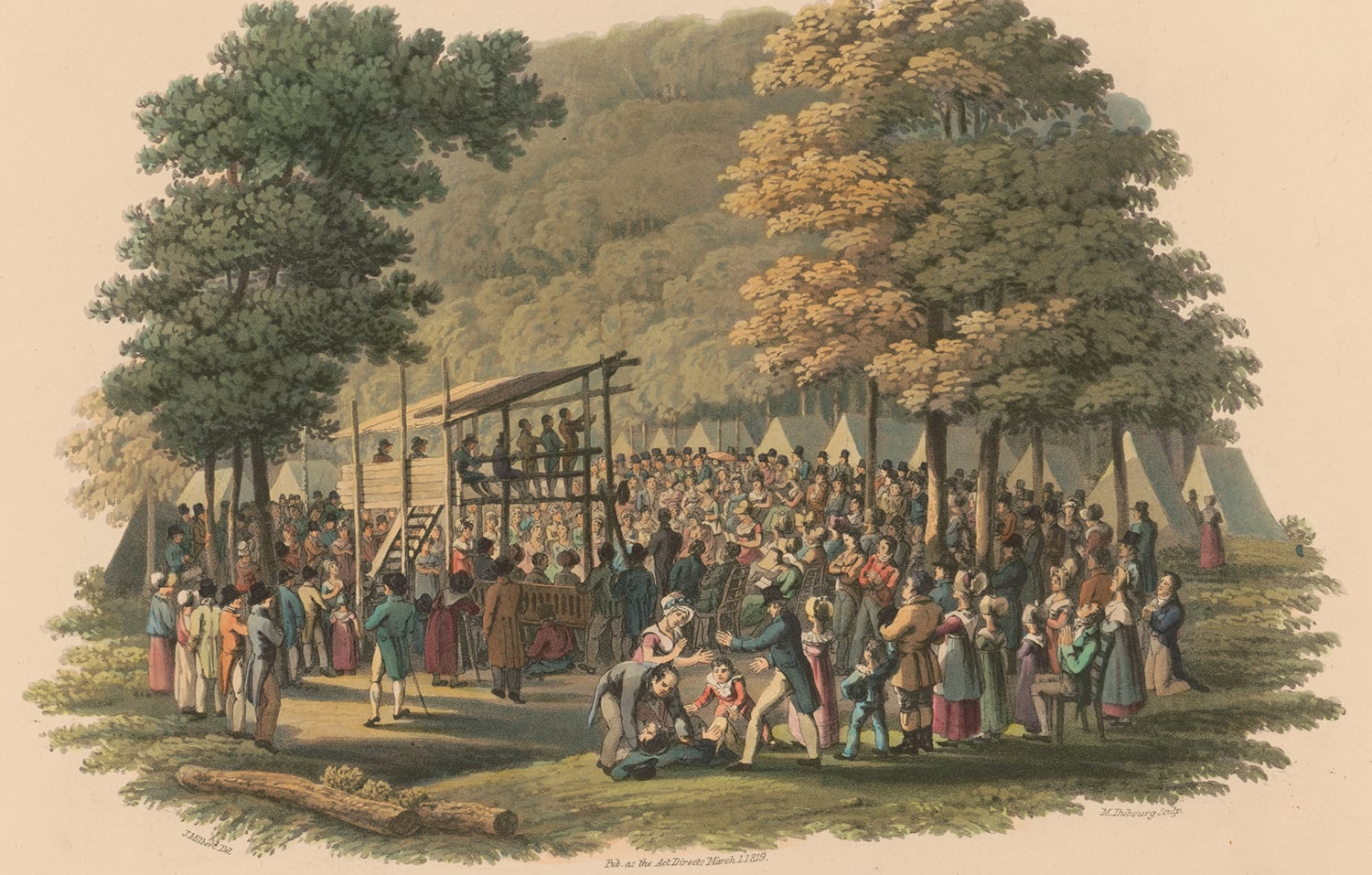
The Kentucky camp meeting revivals of 1800 and 1801 were outdoor gatherings attended by thousands of people travelling from all over the region. The meetings lasted for days and featured evangelistic preaching from different denominations, primarily Methodists, Presbyterians, and Baptists. With such an eclectic gathering of people, many of whom were illiterate, it was impossible to use hymnals and necessary to find music that would either be familiar or easy to learn. The first solution was to fashion short, repetitive refrains from familiar texts that people could learn quickly.1
Publishers rushed to meet the demand for new hymns dedicated to revivals. No longer did they worry about receiving denominational authorization for a hymnal; their main concern was publishing what would be popular. Examples of the many hymnals produced include John C. Totten’s A Collection of the Most Admired Hymns and Spiritual Songs, with choruses affixed as usually sung at camp-meetings (1809), and Peggy Dow’s Collection of Camp-meeting Hymns (1816).2 These collections satisfied the need for revivalistic hymn texts and provided choruses that could be attached to familiar texts or sung on their own.
Compilers saw further opportunity in publishing tunebooks specifically for revivals. In 1824, Asahel Nettleton published Zion’s Harp, a tunebook designed to pair with his Village Hymns for Social Worship (published the same year). In 1830, Joshua Leavitt began to print hymn texts directly alongside tunes in his New York newspaper, The Evangelist. These were published in monthly periodicals, the first six of which were combined into a hymnal, The Christian Lyre, and published in 1831. It met overwhelming acceptance. Westermeyer records that “Two thousand copies were sold in the first few months, and twenty-six editions were published by 1842.”3
The Christian Lyre was significant for more than its union of texts and tunes. It marked a departure from traditions and emphasized the new and the popular. It pushed for the inclusion of rural camp meeting hymn styles in the urban revivals of New York. In his preface, Leavitt explained that Nettleton’s Village Hymns and Zion’s Harp “are wanting in many pieces, which have proved of great use in revivals” and that it was his goal to “embrace the music that is most current among different denominations of christians [sic].”4 Seventy of the 158 texts were less than ten years old, and at least thirteen were published for the first time in the Lyre. Leavitt included familiar texts by Watts and the Wesley brothers, but frequently attached new choruses to them, as with this text by Watts:
Alas! and did my Saviour bleed?
And did my Sovereign die?
Would he devote that sacred head
For such a wretch as I?
[Chorus]
O, the Lamb, the loving Lamb,
The Lamb on Calvary;
The Lamb that was slain,
That liveth again,
To intercede for me.5
He also included the kind of repetitive songs that were popularized at camp meetings, such as this verse:
I’ll try to prove faithful,
I’ll try to prove faithful,
I’ll try to prove faithful, faithful, faithful,
Till we all shall meet above.6
People could easily improvise new stanzas by changing one or two words, similar to a children’s game song.
The tunes Leavitt chose also fit his goal of familiarity. James Downey writes: “The unparalleled popularity of the book was due, in part, to Leavitt’s use of popular tunes drawn from whatever sources were available.”7 These sources included Nettleton’s Zion’s Harp (1824), Ingalls’s The Christian Harmony (1805) and Wyeth’s Repository of Sacred Music, Part Second (1813), but Leavitt felt no qualms about also using tunes from secular sources such as music hall ballads, military marches, sailor shanties, and street songs. Some examples of his contrafacts8 include “Nancy Dawson,” “Home, Sweet Home,” “The Last Rose of Summer,” and the “Marseillaise,” all set to Christian lyrics [see Ex. 1]. Ever valuing simplicity, Leavitt notated the music with only melody and bass lines, rarely inserting an inner harmony.
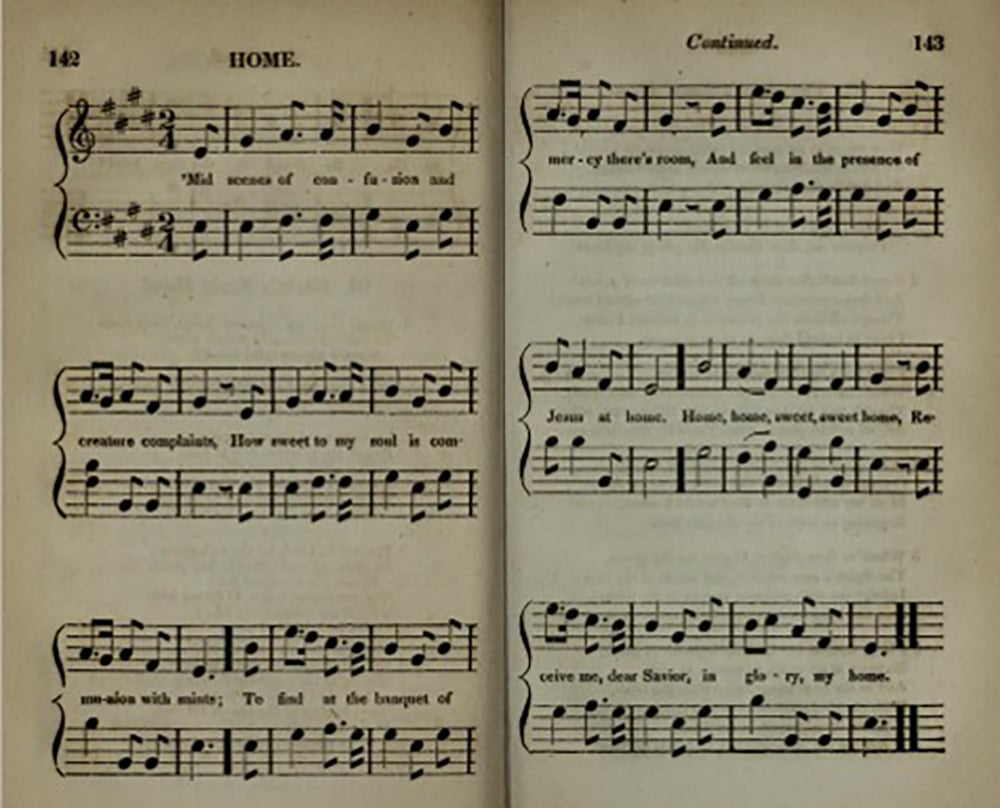
[Example 1: “Home,” a contrafact of “Home, Sweet Home”]9
Leavitt wrote in his preface that he had no musical training “beyond that of ordinary plain singers” and that “the work is not designed to please scientific musicians, so much as to profit plain christians [sic].”10 And “scientific musicians” were not at all pleased. Thomas Hastings, a fellow New Yorker and editor of the Western Recorder, vehemently criticized The Christian Lyre as “‘a species of trash’” and “‘one of the greatest outrages on musical adaptation that can well be imagined.’”11 Hastings had received more musical education than Leavitt, and had made a name for himself as a hymnal compiler, beginning with the Utica Collection (1816).12 He was no opponent to revivals; indeed, he was chosen to be Charles Finney’s musical assistant in 1832 for the New York evangelistic meetings.13 Hastings and Leavitt both agreed that a new kind of simple, devotional hymn tune was necessary for revivals, but fiercely debated what revivals should look like.
In response to The Christian Lyre, Hastings worked with Lowell Mason, a prolific Boston-based composer and music educator, to compile a revival hymnal of his own. Spiritual Songs for Social Worship was published in 1832 in the same kind of format as The Christian Lyre, with tunes printed alongside texts. Out of its 223 texts, it shared thirty-one with the Lyre. Stylistically, the texts were very similar to the Lyre: they used choruses and repetitive verses. However, the two hymnals only had four tunes in common, demonstrating that Hastings’s concern with the Lyre was primarily musical.
Hastings and Mason never accused Leavitt by name, but they lamented that “the public [has] been called upon, in these enlightened days of reform, to recognize in the current love songs, the vulgar melodies of the street, of the midnight reveller, of the circus and the ball room, the very strains which of all others, we are told, are the best adapted to call forth pure and holy emotions, in special seasons of revival!”14 Their primary issue with The Christian Lyre was not its novelty or even its occasional errors of musical grammar, but its blatant use of popular tunes paired with Christian lyrics.
To Leavitt, simplicity meant drawing upon what was familiar to most people. Roth writes, “Because the audience responded to these pieces, his pragmatic belief that music should be evaluated solely by its effectiveness in producing the desired emotions in the listener removed any doubts he might have had about the appropriateness of this practice.”15 Hastings, on the other hand, believed that musical simplicity meant “an unornamented, plain style, easily performed by the musically literate general public.”16 The simply harmonized songs he advocated for would have contrasted with the florid, intricate fuguing tunes in common use and would strictly conform to the rules of counterpoint and harmony. Leavitt saw musical rules as inhibitive to evangelism; his only musical concern was for an effective melody.
Apart from this general difference between their ideas of musical simplicity, Hastings believed that contemporary secular music was utterly inappropriate for religious contexts. The preface to Spiritual Songs conceded that past generations of Christians used secular tunes, but argued that they waited for the tune to lose some of its former association. The Christian Lyre, on the other hand, welcomed popular tunes “in all the freshness of their corruption, still reeking, as it were, with the impure associations which prevail in the haunts of moral pollution!”17
The revival music debate provides a unique perspective on nineteenth-century theological changes. Leavitt’s desire to abandon “scientific” music and embrace popular tunes corresponded to the Arminian belief in individual freedom to accept salvation rather than in following Puritan codes with the fear of not being part of God’s elect. The pragmatism of Charles Finney, who believed that “Preaching was good if it won souls and bad if it did not,”18 matched Leavitt’s use of popular tunes for the reason that they produced results.
Hastings and Mason believed, however, that revivals should produce music of higher standards. They recognized that this music may not be immediately appealing but believed that as new believers grew in faith and spiritual devotion, they would be more inclined to accept higher aesthetic standards.19 They wanted accessible music that would both evangelize and edify. Their “form of populism,” as Roth argues, “was not to lower [their] musical standards to suit the audience, but to help these people attain an appreciation for ‘good’ music by educating them.”20
Apart from the popular music associations, the absence of any glaring musical differences between the revival hymnals of Hastings and Leavitt begs the question of how far Hastings was willing to carry his argument. He seemed more concerned about direct contrafacts of popular songs than about utilizing musical elements of popular styles. Was it permissible, for example, to write a hymn tune that mimicked the style of a popular secular tune if it was not technically a contrafact? In the next article, I will introduce a sub-genre of church music that demonstrated the growing belief that this was not only permissible, but desirable.
[Ed. Note: This series traces the historical development of revival music. As we look back, we also look forward in hope. We need true revival without the excesses of human manipulation that often occur alongside the work that the Holy Spirit is truly doing.]
Bibliography:
Downey, James C. “Joshua Leavitt’s ‘The Christian Lyre’ and the Beginning of the Popular Tradition in American Religious Song.” Latin American Music Review 7, no. 2 (1986): 149-161.
Hastings, Thomas, and Lowell Mason. Spiritual Songs for Social Worship […]. Utica, 1832.
Leavitt, Joshua, comp. The Christian Lyre. New York, 1831.
McLoughlin, Modern Revivalism: Charles Grandison Finney to Billy Graham. Wipf and Stock Publishers, 2004. Originally published in 1959 by Ronald Press Company.
Roth, Lynette. “Heaven, Harmony, and Home: Thomas Hastings’s and Joshua Leavitt’s Dueling Tunebooks.” PhD diss., University of Wisconsin, 1996.
Sanjek, Russell. American Popular Music and Its Business: The First Four Hundred Years. Vol. 2, From 1790 to 1909. Oxford University Press, 1988.
Westermeyer, Paul. Te Deum: The Church and Music. Augsburg Fortress Press, 1998.
- Paul Westermeyer, Te Deum: The Church and Music (Augsburg Fortress Press, 1998), 264. [↩]
- Russell Sanjek, American Popular Music and Its Business: The First Four Hundred Years, vol. 2, From 1790-1909 (Oxford University Press, 1988), 182. [↩]
- Westermeyer, Te Deum, 265. [↩]
- Joshua Leavitt, comp., The Christian Lyre (New York, 1831), 3. [↩]
- Leavitt, The Christian Lyre, 43. [↩]
- Leavitt, The Christian Lyre, 119. [↩]
- James C. Downey, “Joshua Leavitt’s ‘The Christian Lyre’ and the Beginning of the Popular Tradition in American Religious Song,” Latin American Music Review 7 (1986): 153. [↩]
- “contrafact:” verb, “To do the opposite of.” Oxford English Dictionary, “contrafact (v.),” July 2023, https://doi.org/10.1093/OED/9109824107. [↩]
- Leavitt, The Christian Lyre, 142-43. [↩]
- Leavitt, The Christian Lyre, 3. [↩]
- Roth, “Heaven, Harmony, and Home,” 79. [↩]
- Sanjek, American Popular Music and Its Business, 189. [↩]
- McLoughlin, Modern Revivalism, 99. [↩]
- Hastings and Mason, Spiritual Songs for Social Worship, 4. [↩]
- Roth, “Heaven, Harmony, and Home,” 91-2. [↩]
- Roth, “Heaven, Harmony, and Home,” 89. [↩]
- Hastings and Mason, Spiritual Songs for Social Worship, 4. Hastings and Mason, Spiritual Songs for Social Worship, 4. [↩]
- McLoughlin, Modern Revivalism, 87. [↩]
- In the preface to Spiritual Songs they wrote: “Let the simple-hearted Christian, who suddenly awakes, as by a second conversion to the glorious themes of the gospel, sing forth in private, in his family, and in all the small praying circles, the fulness of his glad emotions in the rudest of strains, when nothing more appropriate is at hand…But to seize upon this circumstance for the purpose of forcing such unseemly melodies into general circulation, is just as preposterous as it would be to publish all the broken petitions of prayer or the imperfect expressions of Christian experience that fall from the lips of the new-born soul.” Hastings and Mason, Spiritual Songs for Social Worship, 5-6. [↩]
- Roth, “Heaven, Harmony, and Home,” 105. [↩]
Discover more from Proclaim & Defend
Subscribe to get the latest posts sent to your email.