
Recent discussions about restricting indoor worship sparked my curiosity. Some places allow limited outdoor gatherings, but these are only effective in moderate weather locations. Some places, like the city where I live, have glorious summers that very rarely suffer through extreme heat. Even in our hottest days, outside worship could be tolerable if we were in a reasonably shaded place with a breeze. Other locations are not so fortunate.
While outdoor worship in our summers could be tolerable, other times of the year would be chancy at best. Our main inclement feature is rain. When it rains, the temperatures drop (though we rarely drop below freezing). But with the lower temperatures (and almost constant wind) we have a penetrating wet chill that makes outdoor activities miserable. I would have a hard time meeting in a service where we had to keep dry (or at least, not soaked), and stand in the cold for any length of time. I conducted a graveside service for one of our dear ladies early in the Covid crisis with just a small family group. I tried not to go long, but we were still out there for a good thirty to forty minutes. Some of the younger grandchildren were shaking with our biting cold (and I was none too comfortable myself). At least it wasn’t raining for that half hour!
Other climes than moderate Victoria have extreme weather conditions. Most of Canada and many northern states have snow and freezing weather most of the winter. (Some say that winter lasts ten months, with two months of tough sledding in some of these places.) In the arid southwestern states, summer temperatures can exceed 100° F. daily. “It’s a dry heat,” they say. Well, in heat like that, I’d wilt pretty quick. And then think of the humid southeast with almost as hot temperatures! Outdoors meetings aren’t always the best idea.
Extreme (and sometimes not so extreme) weather conditions can lead to life threatening conditions. According to one website, hypothermia is a risk when the temperature drops below 60° F. Frostbite, heart attack, colds and flu, work-related accidents, depression, and other ailments are risks in extreme cold weather. (See here and here.) In hot weather, heat cramps, heat exhaustion, heatstroke, sunburns, and skin cancer are dangers. (Also see here.) I recall getting dehydrated one summer in Alberta as a boy. The doctor prescribed salt pills (just don’t suck through the candy coating!).
How did people cope with weather like this before the industrial revolution? Well in cold temperatures, they wore lots of layers, including linen next to the skin and woolen garments outside. Furs and leathers also kept folks warm. Fires were kept in homes, with architectural designs to keep heat in and let smoke out. Various devices kept beds warm. My dad told me about heating stones to put in their sleigh on a winters ride into town (this is post Industrial Revolution!) In hot temperatures, people preferred light cotton clothing and designed their homes and public buildings with high ceilings, cross ventilation, and even towers and turrets to carry heat upwards. If you are interested in such things, here is a list of articles describing the efforts to keep warm or cool, depending on the clime:
- How People Kept Houses Cool Before Air Conditioning Was Invented
- How Did Humans Handle Intense Heat Before Air Conditioning Became Popular?
- How Did People Survive the Winter Hundreds of Years Ago?
- A Brief History of Home Heating
- A Brief History of Heating and Cooling America’s Homes
- How Did People Survive Before Indoor Heating?
I am not an expert in these matters, but it seems to me that outdoor services are something that could work on a temporary basis in some locations, but in most locations a permanent move outside would be challenging.
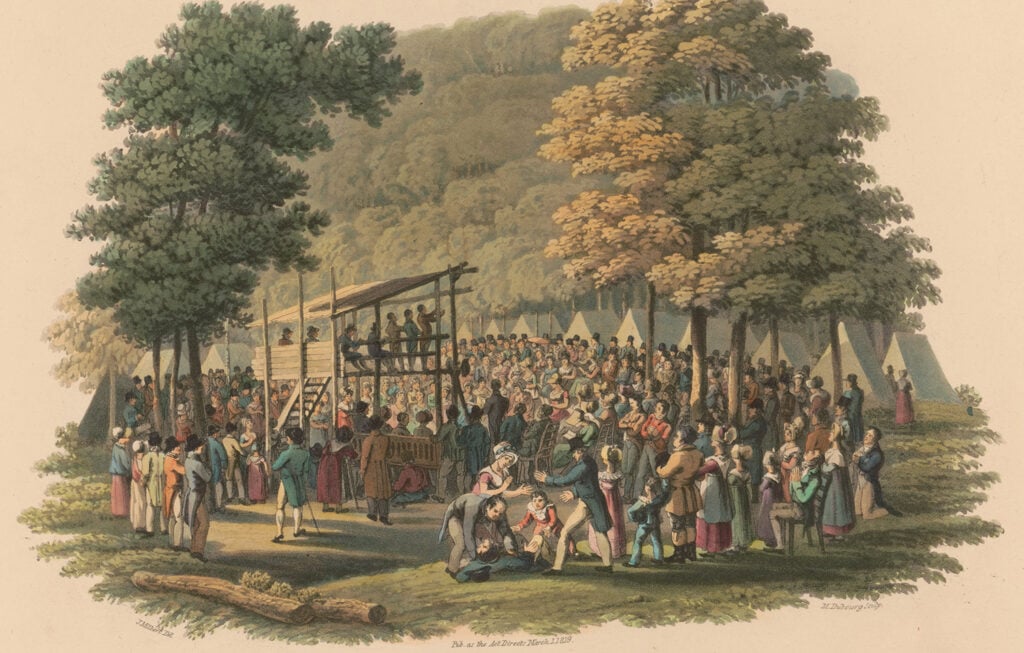
In thinking about this, I wondered about how believers did things when avoiding government officials in places like Soviet Russia not so long ago. My impression is that some such services were outdoors. If the weather was off, how much could we accomplish outdoors? Perhaps a song, a Scripture reading, some prayer, and a brief exhortation and that would be it. Worship would be chancy, and mightily curtailed.
Still, God’s people would meet. Why? Because that is what the church does, and is. The church, to exist at all, must meet. A recent blog I read claimed that the church is changing forever and we need to get used to it. Virtual meetings will replace physical gatherings. I don’t believe it. Virtual meetings are a tool we can use, but nothing replaces the physical gathering. When our church shut down from mid-March to the end of May, a great longing built among us to meet again. We really need the in-person fellowship with one another, the edification, the encouraging one another. Corporate singing really does involve us all ministering to one another as we sing the gospel together. God is at work in the meeting house.
The world really doesn’t understand what corporate worship does for us psychologically and spiritually. They think they can get along without it, or can replace it with cheap, barely adequate substitutes. I know folks who never miss their get-togethers at the Legion, well known for its bar. Others head for bingos or other social organizations. These gatherings meet some psychological needs, but no spiritual needs.
Can we, then, if the world frowns at us (for “health” reasons or otherwise), simply resort to meeting outside, in all weathers? I suppose the church would find a way for such meetings to work, but, honestly, why should we be forced to such extremes? The current narrow focus on public health needs to consider psychological and spiritual health as well as physical health. The church can find ways to meet safely (from a physical perspective) that will promote health from the spiritual perspective. We should not suffer restriction for meeting the whole person needs that we all have. We shouldn’t be forced to risk physical health by outdoor meetings because the state wants to repress indoor meetings.
Don Johnson is the pastor of Grace Baptist Church of Victoria, Victoria, BC, Canada.
Discover more from Proclaim & Defend
Subscribe to get the latest posts sent to your email.