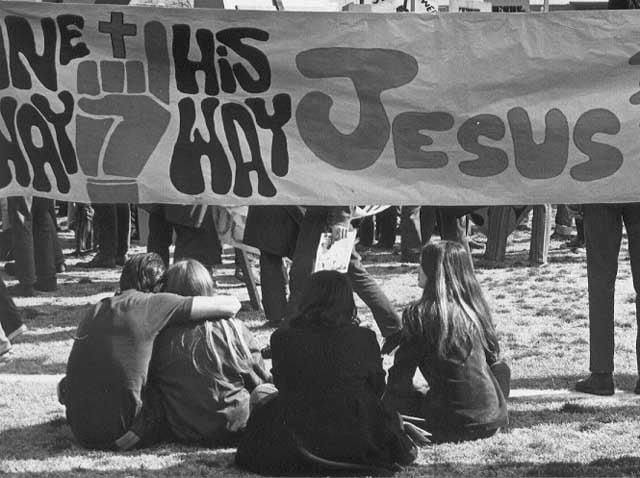
The worldwide release of a new film entitled Jesus Revolution is set for today, February 24, 2023. The film is based on a book by the same title written by Greg Laurie, pastor of Harvest Christian Fellowship in Riverside, CA. The book and the subsequent movie tells the story of Laurie’s conversion during the so-called Jesus Movement of the 1960s and 1970s, centralized in southern California, as well as some of the central features of that movement. Being rooted in the hippie culture, most of those involved in the Jesus Movement were young people who were experimenting with drugs, sex, and religious pursuits. Hippies were a counter-cultural group of adolescents and young adults looking for meaning in life in the face of what they viewed as a meaningless war in Vietnam and a frustrating American political and cultural climate.
The Jesus Movement is said to have been a major spiritual working of God in these hippie sub-cultures, not only in southern California, but also around the nation. Converted hippies in this movement were called “Jesus People” or “Jesus Freaks.” There were, no doubt, many young people who were truly converted and sincere in their faith. However, the Jesus Movement as a whole is not something that should be celebrated as “revolutionary” or exemplary.
The best description of Jesus is not that he’s a revolutionary, but that he is a Redeemer. Jesus did not come to overthrow some kind of political system. While the Jews may have hungered for that to happen, political or even cultural revolution was not Christ’s purpose in his incarnation. The salvation that Jesus provides is not meant to be a politically revolutionary movement either. Neither were Christ’s apostles considered to be revolutionaries. They did not fight for political upheaval. They preached the good news of Jesus Christ and saw lives transformed for the glory of God.
Was the Jesus Movement transformational? When a person reads about the Jesus Movement and its people, transformed lives are not immediately evident. For instance, when Jesus removed the demons from the demoniac of Gadara, that man was transformed. Rather than wild and naked, he was sitting down, dressed, and in his right mind. From what I can gather, the converted hippies largely continued in their hippie lifestyle, still experimenting in drugs and sexual immorality. Their physical appearance identified themselves more with the unconverted hippie movement than with a new life and “new creature” values.
This lack of transformation can perhaps be most easily seen in their leader, a man named Lonnie Frisbee, who is featured in the “Jesus Revolution” book and movie.1 Lonnie Frisbee’s claim of salvation is rooted in a time when he was 17 years old. While on an acid (LSD) “trip” in a California wilderness, he stripped naked and called out, “Jesus, if you’re really real, reveal yourself to me.” He claims to have then seen a vision where hundreds of young people were being baptized in the waters off the coast of California. This sketchy salvation testimony led him to change his appearance to make himself look like an Old Testament prophet, or Jesus (the Hippie Jesus look so prevalent of his day). Frisbee became the de facto leader of the Jesus People movement.
As his prominence grew, Frisbee was integral in the various Jesus People ministries. He was involved in starting several churches and even helped John Wimber formally establish the Vineyard Church Movement. Yet through this time he was also involved in a homosexual lifestyle and continued to experiment with drugs. If any of our churches was found to be led by a man actively involved in homosexuality and hallucinogenic drugs, he would be immediately removed from his position and the church. Lonnie Frisbee is not the kind of Church leader who should be elevated as an example for future Christian generations, as the Jesus Movement and Jesus Revolution does. Because of his deviant lifestyle, Frisbee eventually contracted HIV and died from AIDS in 1993.
The Jesus Movement was built on a theologically weak foundation, with a theologically weak man (if he was even truly converted) as its leader. Yet it has been called a Holy Spirit Revival amongst young people in that day. The movement also produced theologically problematic fruit. It was a major contributor to the modern Charismatic movement, as well as the modern Contemporary Christian Music movement. The high-emotionalism, theologically weak Charismaticism, and undiscerning cultural accommodation of the Jesus Movement have been the key ingredients that have been mixed together to help produce the modern Contemporary Worship scene and make it what it is today. While we should be thankful for any true conversion, we should carefully evaluate both the theological underpinnings as well as the fruit of movements such as these. By their fruit we shall know if they truly are from God, or if they are merely the products of overcharged emotionalism. Ultimately God knows, but as believers who are to be discerning and carefully judge with righteous judgment, we must not simply take everything at face value. Approve those things that are excellent, not merely those things that are exciting.
For further research on the Jesus Movement, consider the following resources:
- God’s Forever Family, the Jesus People Movement in America, Larry Eskridge
- A History of Contemporary Praise & Worship, Understanding the Ideas that Reshaped the Protestant Church, Lester Ruth and Lim Swee Hong
- “Frisbee, the Life and Death of a Hippie Preacher,” a film documentary available for rent on Amazon.
Taigen Joos is the pastor of Heritage Baptist Church in Dover, NH. He blogs here, where this article first appeared. It is republished here by permission.
Discover more from Proclaim & Defend
Subscribe to get the latest posts sent to your email.