Some phrases in the Bible are so familiar that we read right past them. One of these appears in the second chapter of Mark, at the moment Jesus is about to heal a paralyzed man. Jesus announces “the Son of Man has authority on earth to forgive sins.” The healing itself is a wonderful story, and it is easy to get swept up in the crowded house, the hole in the roof, and the man lowered down on his mat. Yet one phrase in the account deserves a closer look. It is the title Jesus uses for himself.
The title occurs eighty-eight times in the New Testament, and eighty-one of those are in the Gospels. Mark alone uses it fourteen times. Usually Jesus uses it of himself, but in John’s gospel, the crowd picks it up and asks Jesus what he means, since they have clearly caught the phrase and have somehow tied it to Jesus. Their understanding is hazy, and they are puzzled when Jesus says, “And I, if I am lifted up from the earth, will draw all men to Myself.” (Jn 12.32). They know he is talking about himself, and they know what the euphemism, “lifted up,” means — it means crucifixion. But, they ask …
“We have heard out of the Law that the Christ is to remain forever; and how can You say, ‘The Son of Man must be lifted up’? Who is this Son of Man?” (Jn 12.34)
They think they get what Jesus has taught about himself, but they do not get this bit about being lifted up. If Jesus is the Christ, how can he die? The question stands: Who is this Son of Man?
Looking Backward First
D. A. Carson observes “The meaning of any term or title depends at least in part on the way it has been used before.”1 That means we must start with the background. For this we must turn to the Old Testament.
There we find four main uses. In Psalm 8, the phrase describes man in his frailty and weakness, and yet God has crowned him with glory and majesty. That matters, because Jesus is the God-man, God who became man to be our substitute on the cross. In some periods of church history, the deity of Christ has been under attack, and in others his humanity has been. Today unbelievers mostly go after his deity, but we dare not forget that we needed a human Savior.
In Psalm 80, the phrase is tied to the vine that God planted, which is Israel. Here the Son of Man is identified with Israel as God’s son, and Jesus, of course, is an Israelite. Even more, some describe Jesus as the Israelite, the quintessential Israelite, so the term seems appropriate that way as well.
In Ezekiel, God addresses the prophet as “son of man” ninety-three times. Daniel also is addressed this way, once in his book. Well, Jesus is a prophet as well, so the designation seems to fit in that sense.
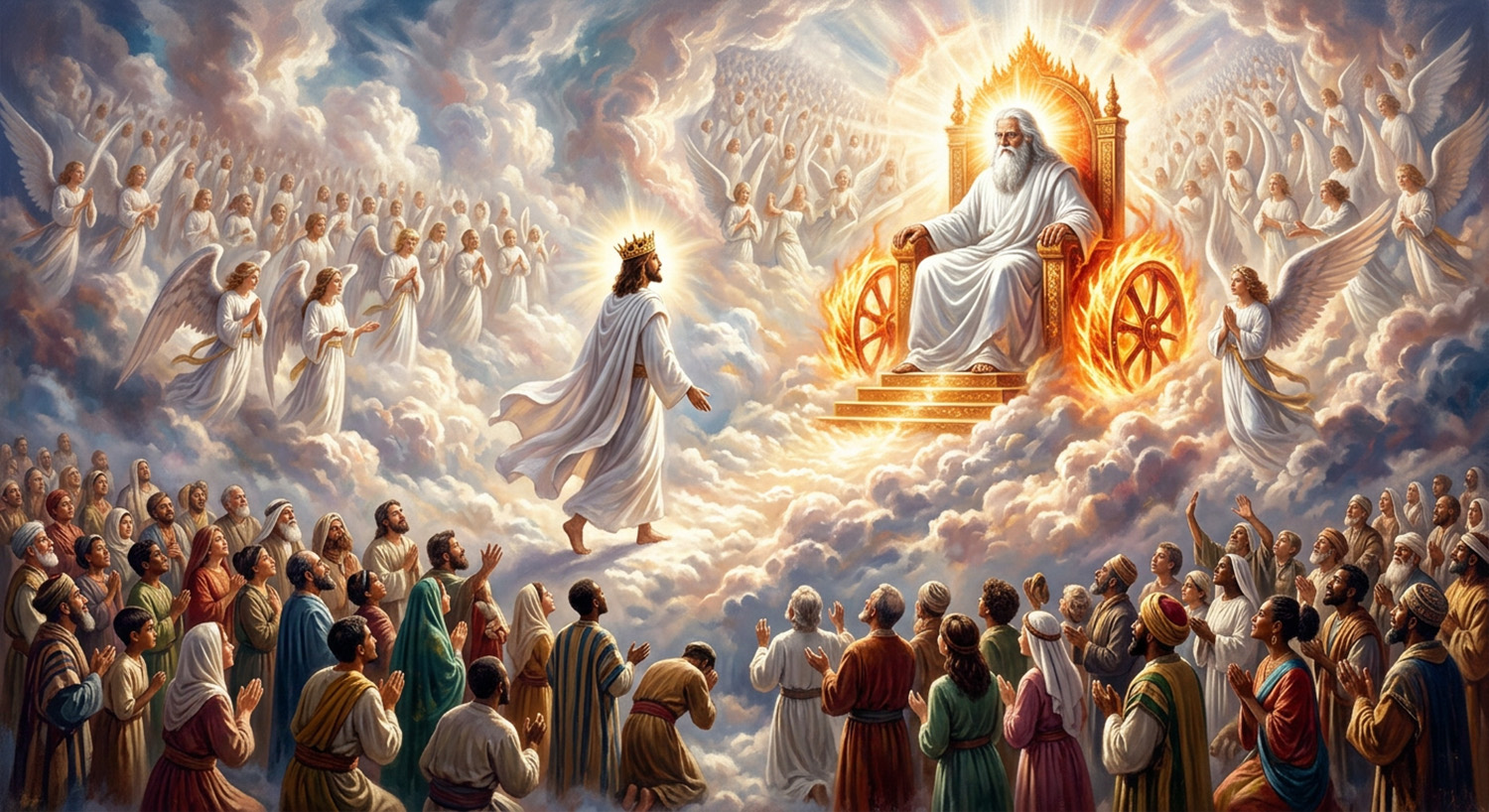
Then comes Daniel 7, which paints a very different picture. One like a son of man comes with the clouds of heaven and is presented before the Ancient of Days, as though he were arriving in the court of a great king. He receives dominion, glory, and an everlasting kingdom.
Dan 7.13-14 “I kept looking in the night visions, And behold, with the clouds of heaven One like a Son of Man was coming, And He came up to the Ancient of Days And was presented before Him. 14 “And to Him was given dominion, Glory and a kingdom, That all the peoples, nations and men of every language Might serve Him. His dominion is an everlasting dominion Which will not pass away; And His kingdom is one Which will not be destroyed.
So, the title carried two connotations in Jewish thought before Christ. One involved humility, humanity, and suffering, and the other involved majesty and glory. There is no evidence, however, that anyone in the first century strongly linked the title to the Messiah. Jesus picked it out of the Old Testament for his own reasons.
A Title Without a Footnote
Every one of the eighty-one uses in the Gospels comes from the lips of Jesus. No one else gives him this title, and the Gospel writers never stop to explain it. It simply appears again and again.
The pattern in Mark is striking. The title shows up twice in chapter 2, and then it disappears for a long stretch. It returns in chapter 8, and from there it appears eleven times. What changed? Peter had just made his great confession that Jesus is the Christ. Immediately after that confession, Jesus began to teach that the Son of Man must suffer many things, be rejected by the elders, chief priests, and scribes, be killed, and rise after three days. He repeated this in chapters 9 and 10, adding that he would be handed over to the Gentiles, mocked, spit upon, and scourged.
The disciples did not get this, or perhaps they did not want to get it. They discussed among themselves what he could mean, and they were afraid to ask, because the plain answer was disturbing. The cross and the resurrection reveal the humble, vulnerable, suffering side of the title.
The other side appears near the end. In chapter 13 Jesus tells his disciples that they will see the Son of Man coming in clouds with great power and glory. At his trial the high priest asks whether he is the Christ, and Jesus answers that he is. He adds that they will see the Son of Man seated at the right hand of power and coming with the clouds of heaven.
Mk 14.61-62 But He kept silent and did not answer. Again the high priest was questioning Him, and saying to Him, “Are You the Christ, the Son of the Blessed One?” 62 And Jesus said, “I am; and you shall see the Son of Man sitting at the right hand of power, and coming with the clouds of heaven.”
This is a direct quotation of Daniel 7, and the council knew exactly what he was claiming. He was claiming divine majesty and prerogatives. They condemned him for it.
This is what the title ultimately means. When this world next sees Jesus, he will come in the clouds with great glory to put things right. I read the headlines, but I do not watch the news. It seems things are getting worse and worse every day. There is a great deal of trouble in the world. I’d rather not hear about it. I want to shut my eyes to the pain that seems coming our way.
Despite the anticipation of much trouble in days to come, ultimately, I am not worried, because the Lord Jesus is coming again. We may suffer in the meantime. I do not relish suffering. I’d rather avoid it. Still, whatever we go through, Jesus is coming again.
Why That Word, in That Room?
Now we can return to Mark 2. Remember who was sitting in that house. There were scribes, experts in the law, and Luke tells us some had come from Jerusalem to check Jesus out. The title was not meaningless to them, though they had not connected it with the Messiah. If Jesus had called himself the Christ, he would have aroused their attention and probably their deep opposition right away. The Son of Man means much the same thing, but it is less well known and a little ambiguous. It could mean man in his weakness, or Israel, or the figure in Daniel. It catches the ear and raises a question.
Then Jesus adds that the Son of Man has authority to forgive sins. Think about how astounding that is for one man to say this to another man:
“Son, your sins are forgiven.” (Mk 2.5)
Anyone would wonder about that man. Just who does he think he is? Jesus backs up the claim by telling the paralytic to get up and walk. The man jumps off his mat, picks it up, and heads home to tell his family, and what a story that must have been to tell.
Meanwhile the scribes sit and watch it happen in front of their eyes. The text does not say what they were thinking, but I am almost certain the thoughts went something like this. “Did he say ‘son of man’?” “He is just a man, is he not?” “Surely he is not saying he will be presented in the court of the Ancient of Days… It must be only an expression.”
A Jarring Figure
This reaction is exactly what Jesus intends. He means to challenge the assumptions of unbelievers whenever they encounter him. Chapter 1 of Mark shows him healing, preaching, and amazing people with his authority. Chapter 2 is the transition where the opposition begins, and from here on we see negativity, rebellion, and rejection.
Jesus is a jarring figure in history, and unbelievers try to redefine him because they do not want to deal with him as he is, the God-man who made the world and came into it to save men from their sins. Something like this happened in the French Revolution. Among its other aims, it tried to reshape the week into ten days, which means nine days of work before a day off. Why do that? They hated God, and the seven-day week goes back to creation, when God worked six days and rested on the seventh. The revolutionaries tried to push God out of their revolution.
Just as the scribes and Pharisees did when Jesus was on earth.
Whenever Jesus is present, he challenges unbelievers, and that includes a room full of people hearing the gospel today. So what effect does he have on you? Do you worship him, scorn him, or try to deflect his attention? He is the one person in all of history whom every man who ever lived must deal with. He is coming with the clouds, and the question is whether you are ready for him.
Image created by Adobe Firefly
- D. A. Carson, “Matthew,” in Matthew, vol. 8, ed. Frank E. Gaebelein, The Expositor’s Bible Commentary (Zondervan, 1984), 210. [↩]
Discover more from Proclaim & Defend
Subscribe to get the latest posts sent to your email.