
A Communion Sunday Reflection on Mark 1:9
The question comes up almost every time we read a passage about the baptism of Jesus: why did Jesus, the sinless Son of God, submit to a baptism that John explicitly offered for the forgiveness of sins? It is not a new question. One well known commentator opens his remarks on the baptism of Jesus by noting that it must have been a genuine problem for the early church. John’s baptism was a baptism of repentance. Jesus had no sin to repent of. So why did he go into the water at all?1
It remains a hard question today, and it is worth admitting up front that the Bible does not answer it directly. The four Gospel accounts are strikingly brief. Commentaries multiply, and they do not all agree, which is itself telling. When a passage is unclear, writers tend to hedge, and when they do commit to an answer, they often spend as much energy disagreeing with each other as explaining the text.
What the Text Actually Says
Mark’s account is almost bare. Jesus came from Nazareth in Galilee and was baptized by John in the Jordan. The narrative moves immediately to the heavens opening and the Spirit descending like a dove, which is really where Mark wants the reader’s attention. The baptism itself gets a single sentence.
Luke adds a little more atmosphere, mentioning that Jesus was praying as heaven opened, but the substance is the same: Jesus was baptized, full stop. No explanation is offered. The point of the passage in Luke, as in Mark, is the divine approval that follows: a voice from heaven declaring him beloved and well pleasing to the Father.
John’s Gospel does not narrate the baptism as an event at all. Instead it records John the Baptist’s testimony about seeing the Spirit descend and remain on Jesus. Again, nothing about why the baptism happened in the first place.
Only Matthew offers anything resembling a reason, and even that answer is cryptic. When Jesus arrives at the Jordan, John tries to refuse him, saying it should be the other way around. Jesus responds that this is necessary in order to fulfill all righteousness. That is an answer, technically. But it does not exactly clear things up. D. A. Carson, surveying all the attempts to explain that phrase, simply concludes that, “Here interpretations are legion.”2 In other words, everybody has a theory and nobody has certainty.
A Survey of the Better Conservative Views
Rather than adjudicate every proposal, it helps to look at where the strongest conservative commentators land, because there is more agreement among them than the range of theories might suggest.
Several point to the idea of identification. Jesus regarded his baptism as the proper way to begin his ministry, not because he had sins of his own to confess, but because in being baptized he joined himself to sinners as their representative, positioning himself to redeem them. Other commentators frame it as complete identification with sinful humanity at the very outset of his ministry: Jesus taking on, symbolically, the role of a lowly penitent, receiving the sign of repentance on behalf of the people of God. The emphasis throughout is representation rather than guilt. He is not confessing sin. He is standing where sinners stand.
One older Lutheran commentator pushes this further, describing Jesus placing himself beside all the sinful people for whom the rite was established, signifying his readiness to take upon himself their guilt. That language of a sacrament goes further than most conservative interpreters would want to go, since a sacrament in that tradition is understood to actually confer holiness. Baptism does not make anyone holy. It makes a person wet. What it does is picture, symbolically, a spiritual transaction that has already taken place. It is a ritual, not a means of grace in itself.
A more Calvinistic reading puts it plainly: the baptism signified that Jesus was going to take upon himself the guilt of the sins of all those for whom he would die. That fits neatly with what happens immediately afterward in John’s Gospel, when John points to Jesus and calls him the Lamb of God who takes away the sin of the world.3
Strip away the theological accents and nearly every serious commentator arrives at the same basic place. Jesus was identifying himself with sinners at the start of his public work.
Reading Mark on Mark’s Own Terms
There is a second angle worth noting, one that has less to do with cross-referencing the four Gospels and more to do with how Mark himself writes. Mark has a habit of introducing major themes briefly, almost in passing, early in his Gospel, and then developing them at length as the narrative unfolds.
The clearest example is the title “Son of God.” It appears in the very first verse, almost as a throwaway identification, and then the entire Gospel becomes an extended argument for that claim, climaxing at the cross when a Roman centurion, of all people, finally says it out loud: “Truly this man was the Son of God.” The question implicit in verse one, whether this man could really be the Son of God, gets answered on virtually the last page.
The same pattern shows up with the announcement that one is coming after John, in Mk 1.7. That single line sets up the entire unfolding story of who Jesus is, tracked through his teaching, his miracles, the gathering opposition from the religious leaders, and finally the cross itself, where the question comes back one more time: is this the one?
If Mark works that way with those themes, it is reasonable to ask whether the baptism notice in Mark 1:9 functions the same way: a small, almost throwaway statement that gets filled in with meaning much later in the book.
The Baptism He Was Actually Talking About
The answer to that question shows up in chapter ten.4 James and John come to Jesus with a request dressed up in polite language but transparent in its ambition: they want the two best seats in his coming kingdom. Jesus asks whether they are able to drink the cup he is about to drink or be baptized with the baptism he is about to undergo. They say, “Yes, we are able,” with more confidence than understanding.
The baptism Jesus means there is not a ceremony in a river. It is death, specifically his death on the cross for the sake of the gospel. That is how his ministry is going to end, and he wants his disciples to reckon honestly with whether they can follow him that far. As it turns out, when the crisis arrives and Jesus is arrested, none of them stand firm. It is easy to be hard on them for that, but anyone honest about one’s own self-preservation would probably do the same. James, notably, did eventually pay that price. The Bible tells us that he was the first of the apostles to be martyred, fulfilling in the end what he had claimed he was able to do.
What Baptism Pictures
At this point we should turn to Romans 6 for some insight (Rm 6.3-4).
Rm 6.3-4 Or do you not know that all of us who have been baptized into Christ Jesus have been baptized into His death? 4 Therefore we have been buried with Him through baptism into death, so that as Christ was raised from the dead through the glory of the Father, so we too might walk in newness of life.
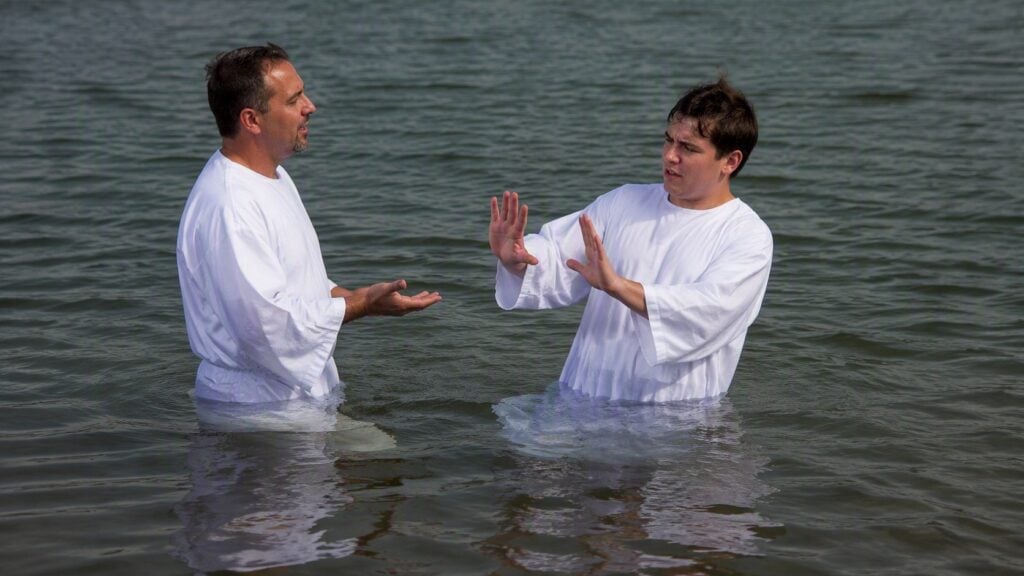
That is exactly what the physical act of baptism pictures. A person goes down into the water, symbolizing identification with Christ’s death, and comes back up out of it, symbolizing resurrection into a new kind of life, one no longer centered on self. Whether that theory actually holds in one’s own daily practice is another matter entirely. But the picture itself is clear: death, burial, and resurrection. Death to sin, and life in God.
Jesus, of course, had no personal need for any of that. He had no sin to bury. But his entire ministry was oriented toward a different baptism, the baptism of the cross, undertaken to save sinners who did need it. So at the very beginning of his public work, in the Jordan River, he was already picturing the end of that work. Going down into the water and coming back up was a kind of visual aid, a preview of what he would actually do: take the place of sinners, undergo the true baptism of the cross, shed his blood, die, and rise three days later so that others could have eternal life.
In that sense, the baptism runs in both directions. Jesus identifies with sinners by standing where they stand, and in doing so he identifies sinners with himself, making it possible for them to be found in him. The baptism in the Jordan is a parable in action of what he intends to accomplish on the cross. He makes the sinner’s cause his own cause. He dies the sinner’s death, so that the sinner can live the life he alone, as Savior, is able to offer.
From the Jordan to the Table
That is the answer, as much as an answer can be given. Jesus was baptized to identify with sinners, acting out ahead of time, in a kind of visual parable, exactly what he intended to do for them on the cross.
The same logic connects the baptism to communion. Both ordinances point to the same reality: his death, burial, and resurrection. In communion, the bread stands for his broken body and the cup for his shed blood, small elements that sustain physical life the same way his sacrifice gives life to the soul. Baptism and the Lord’s table are, in the end, two pictures of a single gospel: a Savior who took the sinner’s place so the sinner could take his.
This article reproduces a sermon preached on August 2, 2026, which you can watch here. We used Claude.AI to turn the transcript into the article. Pastor Johnson has edited and approved the final form of this article.
Image created with Adobe Express.
- Walter W. Wessel, “Mark,” in The Expositor’s Bible Commentary: Matthew, Mark, Luke, vol. 8, ed. Frank Ely Gaebelein, Expositor’s Bible Commentary (Pickering & Inglis, 1984), 621. [↩]
- D. A. Carson, “Matthew,” in Matthew, vol. 8, ed. Frank E. Gaebelein, The Expositor’s Bible Commentary (Zondervan, 1984), 107. [↩]
- For these views compiled in a single list, see Richard C. Blight, An Exegetical Summary of Mark 1-8 (SIL International, 2012), 34. [↩]
- See Mk 10.35-39 [↩]
Discover more from Proclaim & Defend
Subscribe to get the latest posts sent to your email.