The trials of Jesus proceeded rapidly through the night after His arrest in the Garden of Gethsemane.
First Jesus was led to the house of Annas (John 18:12-23). Annas was the former High Priest who had been removed from that office by the Romans. He was the father-in-law of Caiaphas, the present High Priest and was no doubt the real religious authority among the Jews at the time. Annas investigated the situation, questioning Jesus. He quizzed Jesus on what He taught and who His disciples were. Jesus’ only response to Annas was that there was no secret conspiracy. Everything He had done, He had done in the open.
Next, He was taken to Caiaphas and the Council (Sanhedrin) where trumped up charges were sought. Matthew 26:57-67 tells the story. The objective from the beginning was to execute Jesus. They had their man, they just needed a crime to pin on Him. They finally found witnesses who said that they heard Jesus say that He could destroy the Temple and rebuild it in three days.
This was hardly a crime. From an unbelieving perspective, it might seem delusional, but not blasphemous. No doubt impatient with how the trial was proceding, Caiaphas asked Jesus directly, “Tell us if You are the Christ, the Son of God!”
Jesus’ answer led to His condemnation.
Jesus said to him, “It is as you said. Nevertheless, I say to you, hereafter you will see the Son of Man sitting at the right hand of the Power, and coming on the clouds of heaven.” (Matthew 26:64)
At those words, the Sanhedrin erupted shouting “He is deserving of death!”
Our mental images of this event, recorded in the various gospel accounts are often inaccurate. We think of a unanimous guilty verdict, shouted by a vicious crowd as Jesus stood there alone. But, according to a little recognized verse, there was one man, who stood against the bloodlust of His peers. His name was Joseph of Arimathea.
Luke 23:50-51 says,
Now behold, there was a man named Joseph, a council member, a good and just man. He had not consented to their decision and deed. He was from Arimathea, a city of the Jews, who himself was also waiting for the kingdom of God.
Notice some very specific characteristics of Joseph. He, like Nicodemus, was a member of the Sanhedrin. Nicodemus had been a follower of Christ for a long time, likely becoming a disciple during the encounter recorded in John 3. We do not know when Joseph became a follower of Christ, but he is not portrayed as on the fence. He is a devoted follower of Christ even if it might not have been widely known among his peers.
Like Simeon and Anna at the birth of Christ, Joseph, a man of wealth, education, and influence had been looking for the Messiah and the Kingdom to come (Mark 15:43). He was looking for the Messiah even before Jesus came on the scene.
He was a good and righteous man. The message of Christ rang true with these sincere Old Testament believers. They were true believers in the living God and had true faith. These people readily received the message of Christ when it was presented to them.
At the triall of Jesus, Joseph voted “no.” The Sanhedrin was a judicial and legislative body. Such bodies require a vote. It was publicly known that Joseph had not voted with the rest in condemning Jesus to death. There was a lone individual that stood with Jesus at His trial. It was Joseph.
Joseph’s identity as a follower of Christ no doubt endangered him. The Twelve had gone into hiding for fear of their lives when Jesus was arrested and crucified. The image some have of Joseph is that he, like Nicodemus was a secret follower of Christ, unwilling to take the heat publicly.
It is likely that the “fear of the Jews” associated with Joseph’s request for the body of Jesus was not just about his own safety, but also out of concern that the Sanhedrin would intervene and not let him take the body of Jesus for proper burial. Of all people, Joseph would have known the danger of this request. These bloodthirsty religious leaders were his crowd, his own peers.
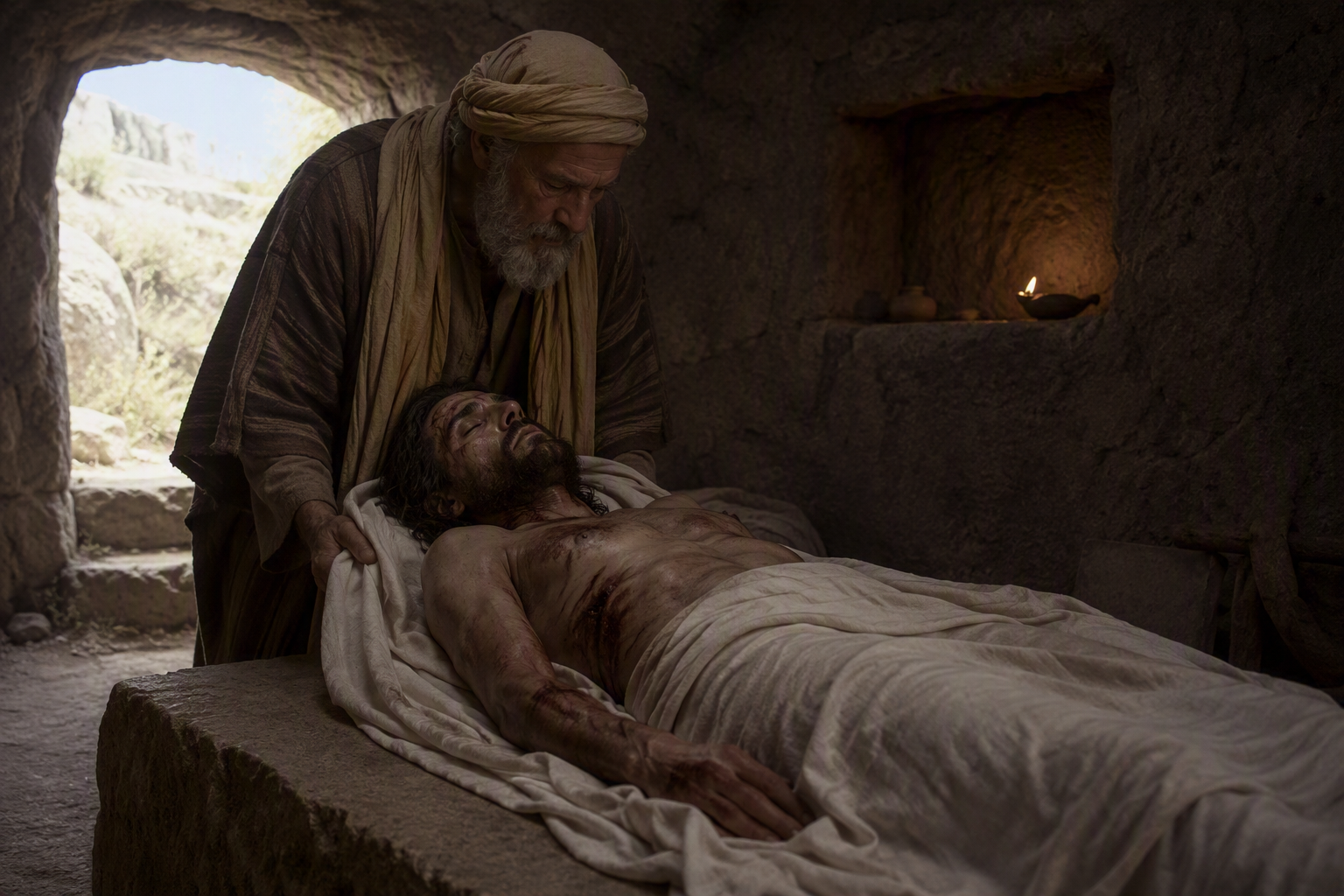
Despite the danger, Joseph approached Pilate and sought the body of Jesus so that He could receive a proper Jewish burial. Joseph knew, like everyone else, that Jesus prophesied that He would rise from the dead after three days. The Council knew it (Matthew 27:62-65) and it is very likely that Joseph was concerned that the body of Jesus might be desecrated to prevent anything like that happening. Thanks to the quick work of Joseph, and the fact that the next day was a Holy Day, Jesus’ body was place in the tomb without further destruction.
Nicodemus brought spices and together with Joseph hurriedly anointed the body of Jesus for burial (John 19:39-40). When the primary disciples of Jesus were in hiding, these two devoted men jumped into action doing what they could for their Lord.
Church tradition maintains that both Joseph and Nicodemus continued in their faithfulness to Christ throughout their lifetimes. Some claim that Joseph was among the missionaries that took the gospel to Europe during the first century. We are not certain of the activities of Joseph and Nicodemus later in life, but we do know that in that dangerous moment when the lifeless body of our Savior needed attention, in spite of mortal danger to themselves, Joseph and Nicodemus took action.
Discover more from Proclaim & Defend
Subscribe to get the latest posts sent to your email.