
On August 21, 2024, Tom Raabe published an article on the American Spectator website entitled, How a Church Fought Back Against a Liberal Takeover—And Won. In his article, he tells the story of the Missouri Synod Lutheran Church and its battle with theological liberalism within the denomination. The story reminded me that every generation of church leaders must fight such battles for theological purity. My concern is that we are not adequately preparing new generations of leadership to fight these battles. If we must fight for the purity of the church, we also must understand the theological foundations for such battles.
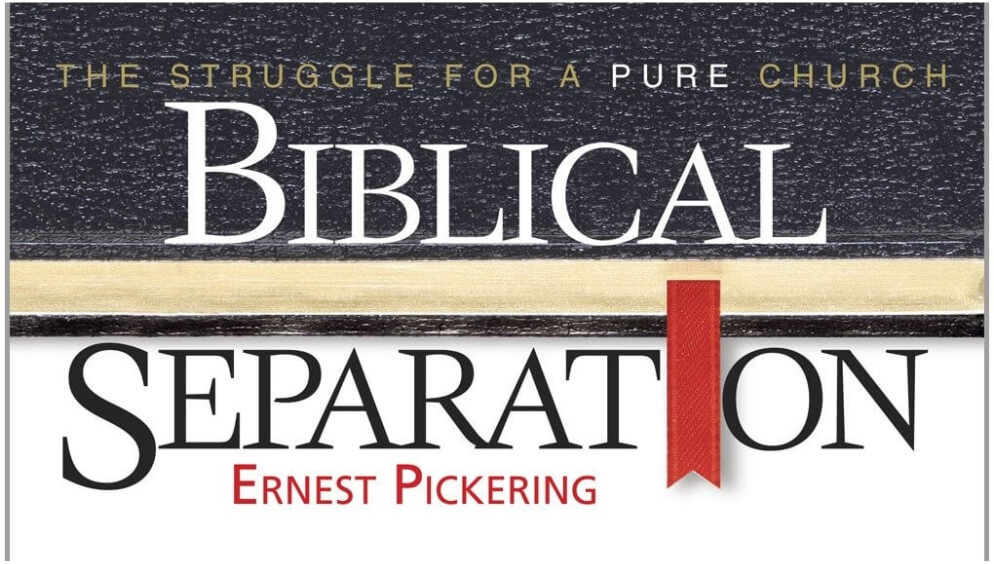
The most effective way to begin that discussion is to interact with what I believe is one of the best and most thorough treatments of the subject. It is Earnest Pickering’s book Biblical Separation: The Struggle for a Pure Church. While the book has been around since the 1970s, there is a version that was published in 2008 and updated by Myron Houghton.
Ernest Pickering graduated from Bob Jones University and received his Th.M. and Th.D. from Dallas Theological Seminary. He taught on the seminary level for many years and as an effective senior pastor in several ministries. He also served as a seminary President. Every minister of the gospel should not only read the book, he should study it thoroughly. I find that many today have only a cursory understanding of the doctrine.
Pickering spends a few chapters dealing with the practice of biblical separation throughout church history, even before the fundamentalist controversy of the early 1900’s. He then details the battles among the Baptists of the Northern Baptist Convention, the Southern Baptist Convention, and other denominations. His comparisons between the choices of the GARBC and the Fundamentalist Fellowship are insightful. The GARBC separated from the NBC early and would not allow dual membership in both the GARBC and the NBC. The Fundamentalist Fellowship sought to reform the NBC from within for more than 20 years, and when they (or should I say “we”) finally pulled out and formed the Conservative Baptist Association, they allowed dual membership in both the NBC and the CBA. This weakness required a later split of the CBA over ecumenical evangelism. Those who opposed ecumenical evangelism left and formed the Fundamental Baptist Fellowship.
I find this interesting because my earliest roots are in the GARBC, and now I find myself President of the Foundations Baptist Fellowship International, which is the modern-day Fundamental Baptist Fellowship.
Pickering’s middle chapters lay a thorough and convincing argument for the practice of biblical separation in all of its aspects and answers arguments against the practice. This is the heart of the book and Pickering’s theological understanding and exposition of the biblical data is excellent. It would make great Bible Study material for a local church.
One of the most remarkable aspects of Pickering’s book is his practical section in which he discusses the implementation of biblical separation and the problems any pastor or group faces. He discusses almost all the questions that we still face today. It is as if he could see into the future. For instance, Pickering addresses the potential dangers of bringing in non separatists to lecture because they are experts in a particular field. He also addresses the danger of having a ministry in which primary purpose is to dig up dirt to publish separation violations of other ministries. He talks about the importance of being gracious.
There are some areas in which the book could use an update—at least by adding a few chapters. There should be an expansion on separation over moral issues, not just theological ones, and that should include woke theology and LGBTQ issues. These issues for today are as important as the theological questions that the early fundamentalists faced.
There should also be a chapter on worship. While worship is not a fundamental of the faith, it is much like the problem of ecumenical evangelism. We can declare what we believe, but our practice can undermine that declaration. We will never agree about everything in worship, but we must address the major dangers and biblical principles involved.
Every pastor must lead a principle-driven ministry, and the principle of separation is a core biblical truth. We must grapple with the biblical data and its implications for ministry—and we must do it honestly and faithfully in every generation.
I still believe that Pickering’s book is the most reasonable place to start that conversation.
Order Biblical Separation: The Struggle For a Pure Church
Also related: For the Faith: A History of the Foundations Baptist Fellowship International
Audio version of this post: Book Review: Biblical Separation: The Struggle for a Pure Church, by Ernest Pickering (substack.com)
Discover more from Proclaim & Defend
Subscribe to get the latest posts sent to your email.